

There is a reason. When the market declines, money doesn’t leave crypto. It goes into USDT. This article explains why.
What Is Bitcoin
Bitcoin has existed since January 2009. It was created by a person or group using the pseudonym Satoshi Nakamoto and has not been identified to this day. There is no company that issues it. There is no headquarters, board of directors, or CEO who can be sued.
It operates on a public blockchain—a ledger distributed across tens of thousands of computers worldwide. Every transaction is permanently recorded and cannot be modified retroactively.
The total supply of Bitcoin is fixed at 21 million units. It cannot be changed. No politician or central bank can decide to print more. Approximately 19.7 million units are already in circulation. The rest will be issued through the mining process until around 2140.
The price of a Bitcoin exceeded $100,000 in 2024. It was also below $16,000 in 2022. Between these two figures lies everything you need to know about its volatility.
What Is USDT
USDT is issued by the company Tether Limited, registered in Hong Kong, with operations in multiple jurisdictions. It was launched in 2014. It is a stablecoin—a cryptocurrency whose price is pegged to the US dollar. 1 USDT = 1 USD.
The mechanism is simple in theory: for every USDT issued, Tether claims to hold equivalent reserves in dollars or similar assets. US government bonds, cash, cash equivalents.
In practice, Tether has had significant transparency issues. In 2021, the US Commodity Futures Trading Commission (CFTC) fined Tether $41 million for falsely claiming that USDT is fully backed by dollars when in reality the reserves were partial and included high-risk assets. Tether did not admit guilt but paid the fine.
Today, Tether publishes quarterly attestation reports. Not full audits. Attestation reports—a significant distinction.
There are approximately 110 billion USDT in circulation currently. It is the largest stablecoin in the world and one of the top 3 crypto assets by market capitalization.
Differences That Matter: Bitcoin vs USDT
Price Stability
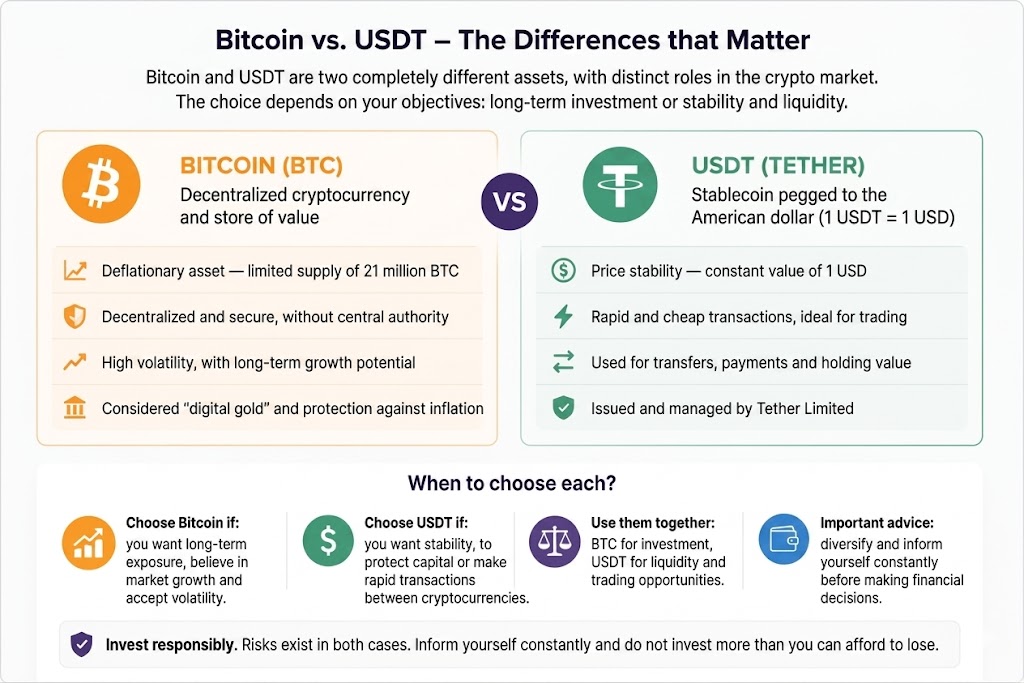
Bitcoin lost 77% of its value between November 2021 and November 2022. USDT remained at 1 dollar during the same period, with fluctuations of a few cents during moments of maximum panic.
There is no asset that rises significantly without also falling significantly. Bitcoin has increased over 600 times compared to its 2013 price. It has also dropped multiple times by 50-80% along the way. Those who cannot tolerate the drops should not buy Bitcoin because they want its returns.
USDT does not decrease. But it also does not increase. It is a tool, not an investment.
Who Controls What
Bitcoin has no owner. The rules of the network cannot be changed unilaterally by anyone. No authority can freeze a Bitcoin wallet without controlling the private key of that wallet.
USDT operates differently. Tether Limited can freeze any USDT wallet address at the request of authorities. It has done so hundreds of times. In 2022, it froze addresses with USDT worth over $360 million at the request of law enforcement from multiple countries. The addresses remain frozen until Tether decides otherwise.
This is not a criticism of USDT. It is a feature. It depends on what you are looking for.
Transaction Speed and Cost
A Bitcoin transaction on the main network takes between 10 minutes and a few hours depending on the fee paid and network congestion. During peak periods, fees have exceeded $60 per transaction.
USDT on the Tron network (TRC-20) is confirmed in 2-3 minutes. The fee is under $1, often a few cents. On the Solana network, confirmation in seconds, fee under $0.01.
For international money transfers, the comparison is not fair. USDT wins categorically on speed and cost.
Returns
Bitcoin has offered, over 4-year periods, returns between 300% and 2,000% compared to the purchase price, for those who bought at the right times. It has also offered losses of 50-80% for those who bought at peaks and sold in panic.
USDT does not offer returns by simply holding it. Deposited on lending platforms or in DeFi protocols, it can generate interest between 4% and 12% annually, depending on the platform and market timing. These interests come with their own risks—platforms can be hacked, can go bankrupt, or can be shut down by authorities.
Real Risks of Each
Bitcoin:
If you lose the private key of the wallet, you lose access to the funds permanently. There is no recovery. There is no customer service. Current estimates suggest that approximately 3-4 million Bitcoin are irretrievably lost due to lost keys or deceased founders.
Volatility is real and documented. It is not speculation that Bitcoin can lose half its value in a few months. It has happened multiple times.
USDT:
The main risk is that you depend on Tether Limited. If the reserves do not exist as declared, the parity with the dollar can break. There was a precedent with another stablecoin, TerraUSD (UST), which lost parity in May 2022 and reached zero in a few days. TerraUSD did not operate on the same mechanism as USDT, but the event showed that stablecoins are not immune to collapse.
Tether is a private company. Its complete financial situation is not public.
How They Are Used in Practice

Bitcoin is mainly bought by three categories of users. Individual investors who hold it long-term as a store of value. Financial institutions—investment funds, treasury companies, ETFs approved in the US since January 2024—that treat it similarly to gold. And users from countries with unstable currencies, who prefer it over the national currency.
USDT is used for trading on exchanges—most trading pairs are X/USDT. For fast and cheap international transfers. As a refuge during market downturns, when traders exit crypto and enter USDT to preserve value. And as a dollar savings tool for users in countries with high inflation.
They are not mutually exclusive. Many users have both.
Where You Can Buy or Sell USDT in Romania
Both Bitcoin and USDT are legally available in Romania. There are no purchase restrictions.
Where you can buy USDT:
Abarai, Binance, Kraken, Coinbase, Revolut, MoonPay. Most platforms accept card or bank transfer and require identity verification (KYC). Revolut and MoonPay are simpler to use but have higher fees. Dedicated exchanges—Binance, Kraken—offer lower fees and more control, in exchange for a longer registration process.
Where you can sell USDT and receive RON:
Abarai, Binance, Kraken, Coinbase, Revolut. Not all platforms allow direct withdrawal in lei—check available withdrawal options for Romania beforehand.
What to Choose
If you want to invest long-term and can tolerate significant price fluctuations—Bitcoin.
If you want to send money quickly and cheaply to another country—USDT on Tron or Solana.
If you want to temporarily exit the crypto market without selling into fiat currency—USDT.
If you want to earn interest without volatility, with different risks—USDT on lending platforms.
If you want an asset that does not depend on any company or government—Bitcoin.
There is no universal answer. There is your specific context and the right tool for it.
What Remains to Know
Bitcoin is 15 years old. It has never been hacked at the protocol level. It has survived multiple predictions of its disappearance and multiple collapses of companies around it—Mt. Gox in 2014, FTX in 2022.
USDT is 10 years old. It has survived multiple liquidity crises and multiple waves of doubt about its reserves. It remains dominant.
Both exist because they solve real problems. Neither is perfect.
Do your research before buying either of them. Not because it’s a mandatory closing phrase, but because the crypto market has eliminated enough people who didn’t.
Sources
[1] CFTC Orders Tether and Bitfinex to Pay Fines Totaling $42.5 Million — Commodity Futures Trading Commission, October 15, 2021
[2] Tether Freezes $5.2M USDT in Response to Phishing Scams — Yahoo Finance: “By late 2022, over $360 million had been frozen”