Crypto Ramp or Crypto Exchange – What is the Difference?
Short answer
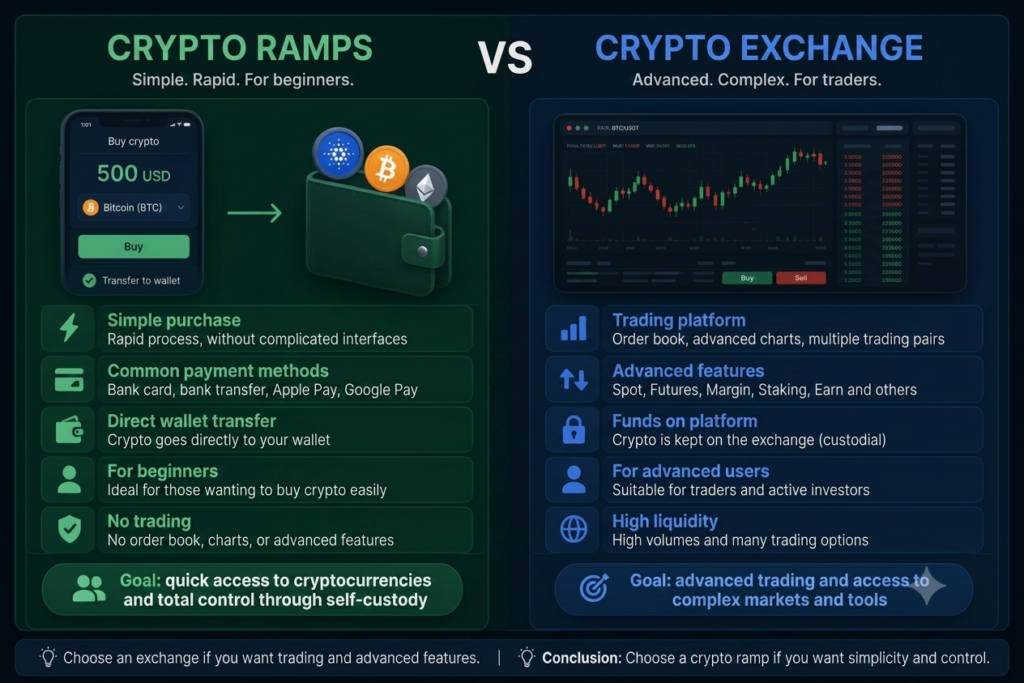
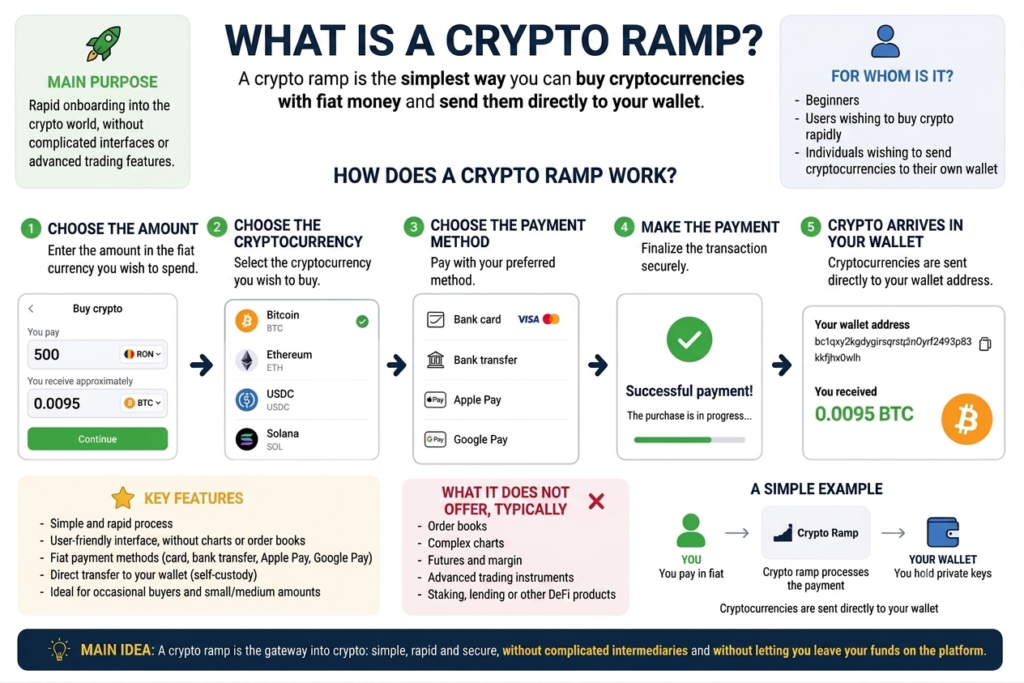
A crypto ramp is a platform built for buying or selling cryptocurrencies quickly, by card or bank transfer. A crypto exchange is designed for active trading and portfolio management. If you just want to buy Bitcoin or Ethereum and send them to a personal wallet, a crypto ramp is usually the simpler choice.
A crypto ramp works like a classic currency exchange — you come with money, receive the equivalent in cryptocurrency directly in your wallet, and at no point do the funds remain on the platform. You pay by card or bank transfer, enter your wallet address, and you’re done.
What is a crypto ramp
For small amounts, the process is fast and requires no extensive verification. For larger amounts, the platform will ask for an identity document — a standard requirement under AML regulations. No charts, no order books, no trading settings.
✓ Crypto ramp advantages
Simple process, just a few steps
Crypto delivered directly to your wallet
No complex account required
No learning curve
✗ Crypto ramp limitations
No active trading
No limit orders or futures
Smaller coin selection
Not for advanced traders
Crypto ramp examples
Abarai — global, 160+ countries
MoonPay — global
Transak — global
Ramp Network — global
What is a crypto exchange?
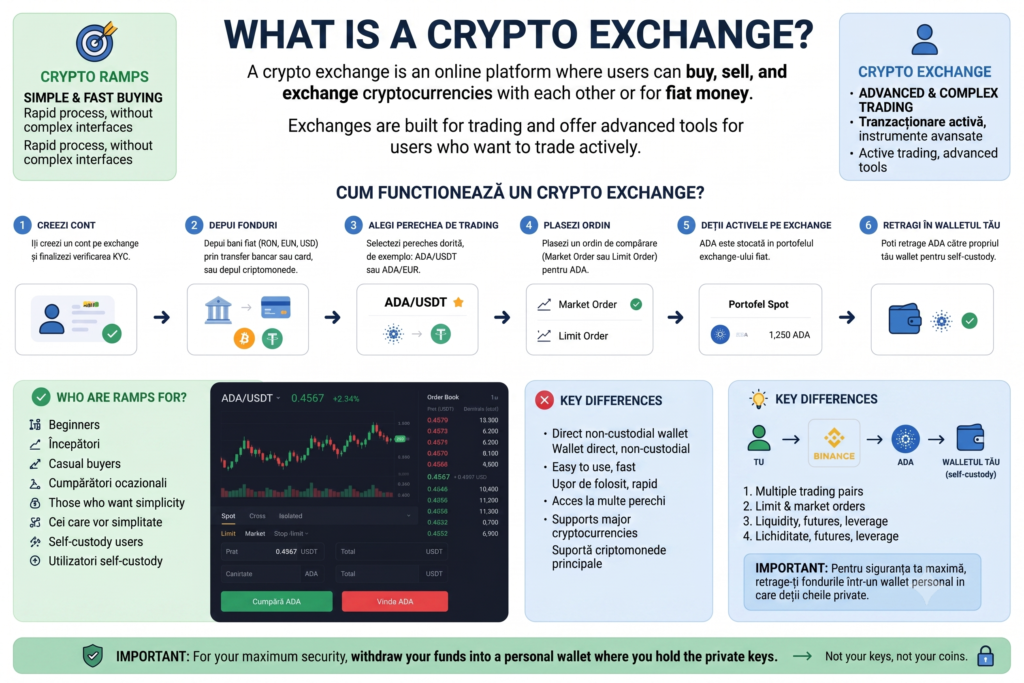
A crypto exchange resembles a bank more than a currency exchange. It’s not enough to show an ID — you need to prove your home address, sources of income, and go through an extensive verification process (full KYC). Once your account is open, you have access to a full trading platform.
What is a crypto exchange ?
Unlike a ramp, on an exchange the cryptocurrencies you buy remain in the platform’s custody until you manually withdraw them to your own wallet.
Manually withdraw to your wallet (transaction enters pending and is approved afterward)
Duration: hours to days. Mandatory KYC.
What is self-custody and why does it matter?
Self-custody means that you hold the private keys to your wallet — not a platform on your behalf. If the exchange is hacked (private keys are lost), becomes insolvent, or freezes withdrawals, your funds are outside the risk.
“Not your keys, not your coins” — the fundamental principle of self-custody. The FTX collapse (2022, ~$8 billion in frozen funds) proved that even the largest exchange is not immune. Crypto ramps that send directly to your wallet eliminate this risk from the start.
🔑 Self-custody (your own wallet)
You hold the private keys
Nobody can freeze your funds
Full responsibility on the user
🏦 Custodial (exchange)
The platform holds the keys
Risk if the platform has issues
Recovery possible via support
When don’t you need a crypto exchange?
Many users open an account on Binance or Kraken out of habit — without actually needing 90% of the features offered. A full exchange isn’t necessary if:
Many users use both — a ramp for the initial card purchase directly to their wallet, and an exchange only when they need advanced features. They are not mutually exclusive options.
Is a crypto ramp or an exchange safer?
Safety depends more on how you manage your funds than on the type of platform. Regardless of what you use, a few basic rules always apply:
✓Enable two-factor authentication (2FA) on every platform
✓Always verify the first and last 6 characters of an address before any transfer
✓Don’t leave large amounts on exchanges long-term
✓Store your seed phrase offline, never digitally (only if you use a crypto ramp)
Frequently asked questions
Can I buy crypto without an exchange?
Yes. Through a crypto ramp you can buy cryptocurrencies directly by card or bank transfer, without creating a trading account or going through extensive KYC verification. The cryptocurrencies go directly to your personal wallet.
What is the difference between a wallet and an exchange?
A wallet stores your cryptocurrencies and gives you control of the private keys. An exchange is a trading platform — funds are in their custody until you withdraw them. You can read more about crypto wallets in the guides on hot wallets and cold wallets.
Is self-custody mandatory?
No. You can keep your cryptocurrencies on a custodial exchange — it’s simpler if you trade frequently. But if you hold crypto long-term or own significant amounts, self-custody reduces dependence on third-party platforms and the risk of losing access if the platform has issues.
Does a crypto ramp or an exchange have lower fees?
It depends on the type of transaction. Exchanges have lower trading fees (0.1–0.25% per trade), but add charges for card deposits (1.8–3%) and withdrawals. Ramps have more visible per-transaction fees but cover the full process — no hidden withdrawal fees or extra steps.
Can I use a crypto ramp if I want to trade actively?
A ramp is not built for active trading — you won’t have order books, charts, or limit orders. If your goal is frequent trading or access to advanced instruments, an exchange like Kraken or Binance is the right choice.
Where does the term “crypto ramp” come from?
The term comes from the expressions “on-ramp” and “off-ramp” used in the crypto world — by analogy with highway on-ramps and off-ramps. An on-ramp is the point where you enter the crypto ecosystem (you buy with fiat money), and an off-ramp is the point where you exit (you sell crypto and receive fiat money back).