SHA-256 (Secure Hash Algorithm 256-bit) is a cryptographic hash function that transforms any input data into a unique 256-bit digital fingerprint. It is the algorithm that secures the Bitcoin blockchain — used in mining, transaction validation, and the Proof of Work consensus mechanism.
SHA-256 is a cryptographic hash algorithm that takes any input — a word, a document, a block of transactions — and produces a unique 256-bit output called a hash. No matter how large or small the input is, the result is always exactly 64 hexadecimal characters long.
It belongs to the SHA-2 family of algorithms, developed by the US National Security Agency (NSA), and is one of the most widely used cryptographic algorithms in the world. In the crypto space, SHA-256 is the backbone of the Bitcoin network — powering everything from mining to transaction validation.
Simple analogy: Think of SHA-256 as a meat grinder. You can put anything in — a sentence, a file, a block of transactions — and it always comes out as a fixed-size, completely unrecognizable output. But the same input always produces the same output, and you can never reconstruct the original from what came out.
How does SHA-256 work?
SHA-256 takes an input of any size and processes it through a series of mathematical operations, producing a fixed-length output of 256 bits — always 64 hexadecimal characters.
Change a single character in the input — even one letter — and the output hash changes completely. This property is called the avalanche effect.
This makes SHA-256 extremely useful for detecting tampering: if even one byte of data changes, the hash changes entirely — making it immediately obvious that something has been altered.
Key properties of SHA-256
🔁
Deterministic
The same input always produces the exact same hash — every time, on every device, without exception.
📏
Fixed length
The output is always 256 bits (64 hexadecimal characters), regardless of whether the input is one word or an entire book.
🛡️
Collision resistance
It is computationally infeasible for two different inputs to produce the same hash. Finding a collision would require more computing power than currently exists on Earth.
🔒
One-way function
Given a hash, it is impossible to reconstruct the original input. The process is mathematically irreversible.
🌊
Avalanche effect
A tiny change in the input — even one character — produces a completely different hash. There is no gradual change: the output is entirely different.
⚡
Fast to compute
Generating a hash is computationally fast. Verifying a hash is near-instant. This makes SHA-256 practical for high-throughput applications like blockchain.
SHA-256 and Bitcoin
SHA-256 is the cryptographic foundation of the Bitcoin network. It is used in four critical functions:
Generating block hashes
Every block in the Bitcoin blockchain has a unique hash generated by SHA-256. This hash acts as the block’s fingerprint and is included in the next block — creating the chain.
Validating transactions
Each transaction is hashed with SHA-256 as part of the verification process. This ensures that transaction data hasn’t been tampered with between broadcast and confirmation.
The mining process
Bitcoin miners perform billions of SHA-256 calculations per second, competing to find a hash that meets the network’s difficulty target. When a miner finds it, they earn the block reward. This is the core of mining.
The Proof of Work mechanism relies entirely on SHA-256. Finding a valid hash requires real computational work — making it expensive to attack the network and impossible to fake.
Bitcoin actually applies SHA-256 twice in sequence (double SHA-256) for additional security. This makes brute-force attacks even more computationally expensive.
SHA-256 in the blockchain
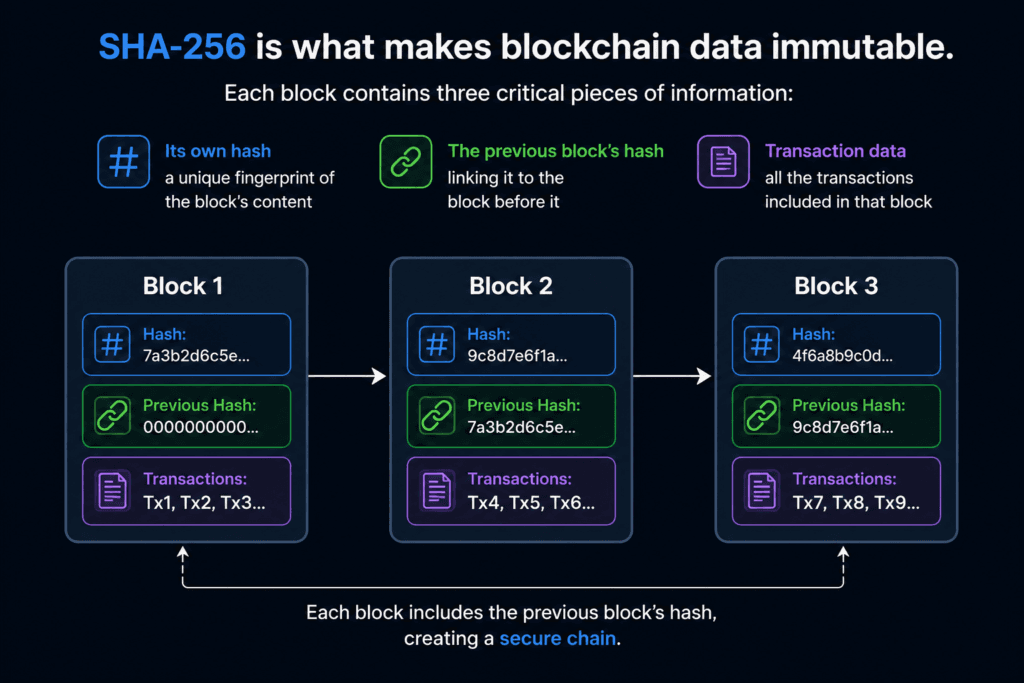
SHA-256 is what makes blockchain data immutable. Each block contains three critical pieces of information:
Its own hash — a unique fingerprint of the block’s content
The previous block’s hash — linking it to the block before it
Transaction data — all the transactions included in that block
What is SHA-256
This structure creates a chain where every block is cryptographically linked to the one before it. If someone tries to alter a transaction in an old block, its hash changes — which breaks the link to the next block, and every block after it. Altering history requires redoing the Proof of Work for every subsequent block — an attack that would require more computing power than the entire Bitcoin network combined.
SHA-256 in action — sending Bitcoin
Here’s what happens at the SHA-256 level every time someone sends Bitcoin:
Step 1 — Transaction is broadcast
The transaction is signed and broadcast to the Bitcoin network, where all nodes receive it.
Step 2 — SHA-256 hashing
The transaction data is processed through SHA-256 (twice), generating a unique transaction ID (TXID).
Step 3 — Miners compete
Miners include the transaction in a candidate block and perform billions of SHA-256 calculations to find a valid block hash.
Step 4 — Block confirmed
The block is added to the blockchain. The transaction is confirmed and permanently recorded. The SHA-256 hash of this block is stored in the next block.
Where else is SHA-256 used?
SHA-256 isn’t exclusive to Bitcoin. It’s embedded in much of the internet’s security infrastructure:
Due to cryptographic vulnerabilities discovered in SHA-1, it is no longer considered safe for security-critical applications. SHA-256 (and the broader SHA-2 family) is the current standard, with SHA-3 available as an alternative for applications requiring a completely different algorithmic design.
Frequently asked questions about SHA-256
What does SHA-256 stand for?
SHA-256 stands for Secure Hash Algorithm 256-bit. It refers to the length of the output hash — always 256 bits, or 64 hexadecimal characters.
Is SHA-256 used by Bitcoin?
Yes. Bitcoin uses SHA-256 as the core algorithm for its mining process, block hashing, transaction validation, and Proof of Work consensus mechanism. It applies SHA-256 twice in sequence (double SHA-256) for additional security.
Can a SHA-256 hash be decrypted?
No. SHA-256 is a one-way function — given a hash, it is mathematically impossible to reconstruct the original input. This is by design: if it could be reversed, it would be useless as a security tool.
Is SHA-256 the same as encryption?
No. Encryption is reversible — data is scrambled and can be unscrambled with the right key. Hashing with SHA-256 is irreversible — data goes in, a fixed-size fingerprint comes out, and the original cannot be recovered. They serve different purposes: encryption protects data in transit, hashing verifies data integrity.
Why is SHA-256 important for blockchain security?
SHA-256 ensures that any tampering with block data is immediately detectable. Because each block contains the hash of the previous block, altering any historical data would change that block’s hash — breaking the chain and requiring an impossible amount of recalculation. This is what makes blockchain records effectively immutable.
Could quantum computers break SHA-256?
Theoretically, sufficiently powerful quantum computers could weaken SHA-256’s security. However, the quantum computers needed to pose a real threat don’t yet exist, and the Bitcoin community is already researching post-quantum cryptographic alternatives. This is a known long-term consideration, not an immediate threat.
SHA-256 hash function cryptography bitcoin mining blockchain proof of work crypto dictionary