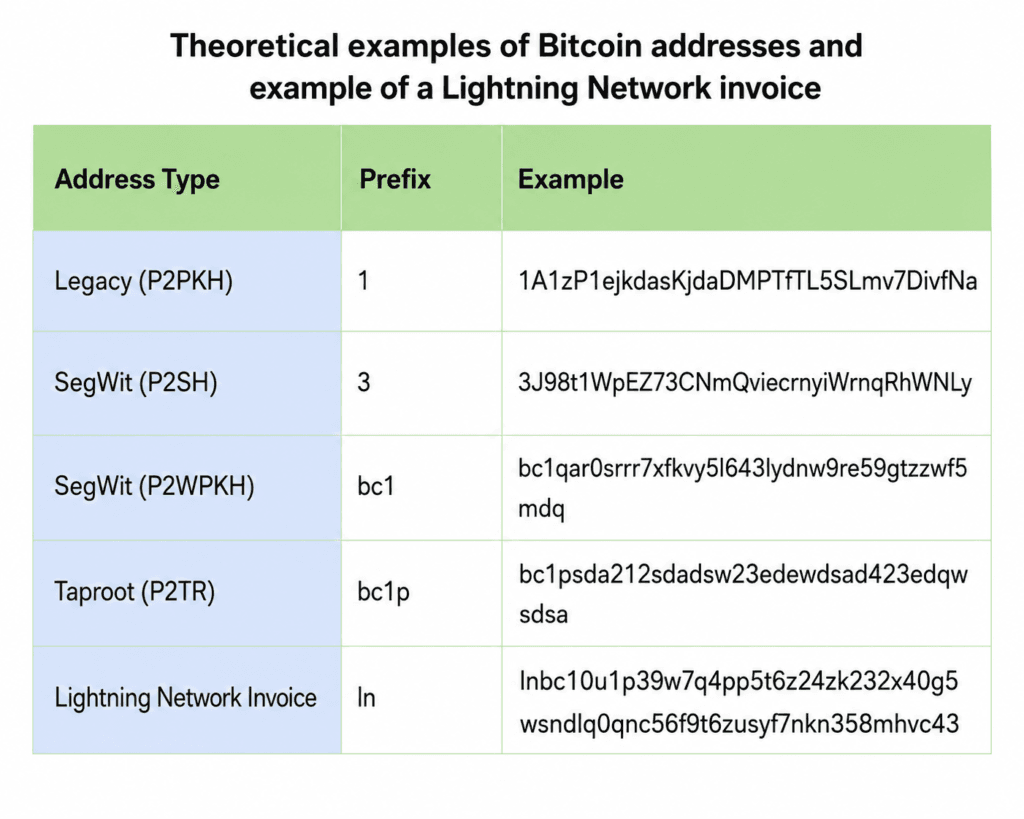
A Bitcoin address is the equivalent of an IBAN — a unique string of characters you give to someone to send you Bitcoin. There are 5 main types: Legacy (1…), SegWit (3…), Native SegWit (bc1q…), Taproot (bc1p…), and Lightning (lnbc…). For general use, Native SegWit is the recommended option — low fees and good compatibility.
A Bitcoin address is the equivalent of a bank IBAN — a unique identifier you give to someone to send you Bitcoin. Just like giving someone your account number for a transfer, you give your Bitcoin address to receive BTC.
Technically, a Bitcoin address is a string of letters and numbers, between 25 and 62 characters long, cryptographically generated from your public key. It looks like this: bc1qw508d6qejxtdg4y5r3zp3t5nrs0c5r3qvrtlsh
bitcoin address : examples and types
An important thing to understand from the start: the Bitcoin address is not the same as your wallet. A crypto wallet can generate hundreds or thousands of different addresses — all controlled by the same seed phrase. The address is just the “entry door,” not the vault itself.
Complete analogy: If your wallet is the bank, the Bitcoin address is the account number. The seed phrase is the master password. The private key is your signature. You can give anyone the account number (address) — no one can take money from it without your signature (private key).
How does a Bitcoin address work?
The Bitcoin address works based on public and private key cryptography — the same principle banks use to secure transfers, but without a central authority.
How to receive Bitcoin
Give your Bitcoin address to the person who wants to send you funds. They enter your address into their wallet and confirm the transaction. Bitcoin reaches your address in a few minutes, after confirmation on the blockchain.
How to send Bitcoin
Enter the recipient’s address into your wallet, specify the amount, and confirm with the private key (usually automatically, via PIN or biometrics). The transaction is cryptographically signed and broadcast to the network.
How the address is generated
The address is mathematically derived from the public key, which in turn is derived from the private key. The process is irreversible — you cannot deduce the private key from the address. That’s why it’s safe to give your address to anyone.
Address ≠ private key
The address is public — you can give it to anyone without risk. The private key is secret — whoever holds it controls the funds. Do not confuse the two and never give your private key or seed phrase to anyone.
What types of Bitcoin addresses exist?
Bitcoin has evolved over the years, and so have address formats. Currently, there are 5 main types, each with different characteristics in terms of cost, speed, and compatibility.
1. Legacy (P2PKH) — starts with 1
The first and oldest type of Bitcoin address, created with the launch of the network in 2009. P2PKH stands for Pay to Public Key Hash. They are the simplest and accepted by absolutely all wallets and platforms — but also the most expensive in terms of network fees.
✓ Advantages: Universally compatible, accepted by any platform or wallet without exception
✗ Disadvantages: Higher fees compared to modern types, larger transaction sizes
Real example: 1A1zP1eP5QGefi2DMPTfTL5SLmv7DivfNa — the first Bitcoin address, belonging to Satoshi Nakamoto. It still holds ~100 BTC intact.
2. SegWit (P2SH) — starts with 3
P2SH (Pay to Script Hash) addresses emerged as a transitional bridge between Legacy and Native SegWit. They separate transaction signatures from actual data — transactions become up to 40% smaller than Legacy, resulting in lower fees and faster confirmation. They also support advanced functionalities like multi-signature.
✓ Advantages: Good compatibility, lower fees than Legacy, multi-sig support
✗ Disadvantages: Not as efficient as Native SegWit (bc1q), less clear address format
Example: 3J98t1WpEZ73CNmQviecrnyiWrnqRhWNLy
3. Native SegWit (P2WPKH) — starts with bc1q ⭐ Recommended
The complete and native implementation of SegWit — the most efficient type of address for regular transactions. Average fees are ~40% lower than Legacy, transactions confirm faster, and the address format is less prone to typing errors. It is the recommended type for most users.
✓ Advantages: Low fees, good speed, compatible with all modern platforms, improved error detection
✗ Disadvantages: A few very old platforms do not accept it yet — increasingly rare
The newest Bitcoin address standard, activated in November 2021 through the Taproot upgrade. The main innovation is privacy: complex transactions (multi-sig, smart contracts) look identical to simple ones on the blockchain, without revealing the type of operation. It also allows for more sophisticated contracts on the Bitcoin network.
✓ Advantages: Enhanced privacy, greater efficiency for complex transactions, foundation for future functionalities
✗ Disadvantages: Growing adoption but not universal, some exchanges do not fully support it yet
Lightning Network is a layer 2 built on top of Bitcoin, allowing instant transactions with almost zero fees, without recording each payment on the main blockchain. It is not a classic Bitcoin address — it is an invoice with a limited validity period, generated for a specific amount. Ideal for frequent payments and small amounts.
✓ Advantages: Instant transactions, almost zero fees, perfect for merchants or frequent payments
✗ Disadvantages: Invoice expires, requires Lightning-compatible wallet, not ideal for large amounts
Example: lnbc123u1p3xnhl2pp5...
How to choose the right type of address?
In practice, your wallet automatically chooses the address type. But if you have a choice or want to understand what you’re using, here’s a quick guide:
Important: It doesn’t matter what type of address you use — what matters is that the sender and recipient are on the same network. Do not send BTC to an Ethereum address or an incompatible network. Always check the first and last 6 characters of the address before any transaction.
What is a Bitcoin address made of?
Any Bitcoin address consists of three components that work together to identify the recipient and prevent errors:
1. Prefix
The first characters of the address indicate the type — 1 for Legacy, 3 for P2SH, bc1q for Native SegWit, bc1p for Taproot. By looking at the first characters of an address, you can immediately identify its type.
2. Public key hash
The body of the address is an encrypted version of your public key. It uniquely identifies the transaction recipient. The transformation process is mathematically irreversible — you cannot deduce the public key from the address, let alone the private key.
3. Checksum
A verification code included in the address that automatically detects typing errors. If you enter an address with a mistake, the wallet will invalidate it before sending — an essential protection mechanism. That’s why you can’t send BTC to a “made-up” address.
What is a change address?
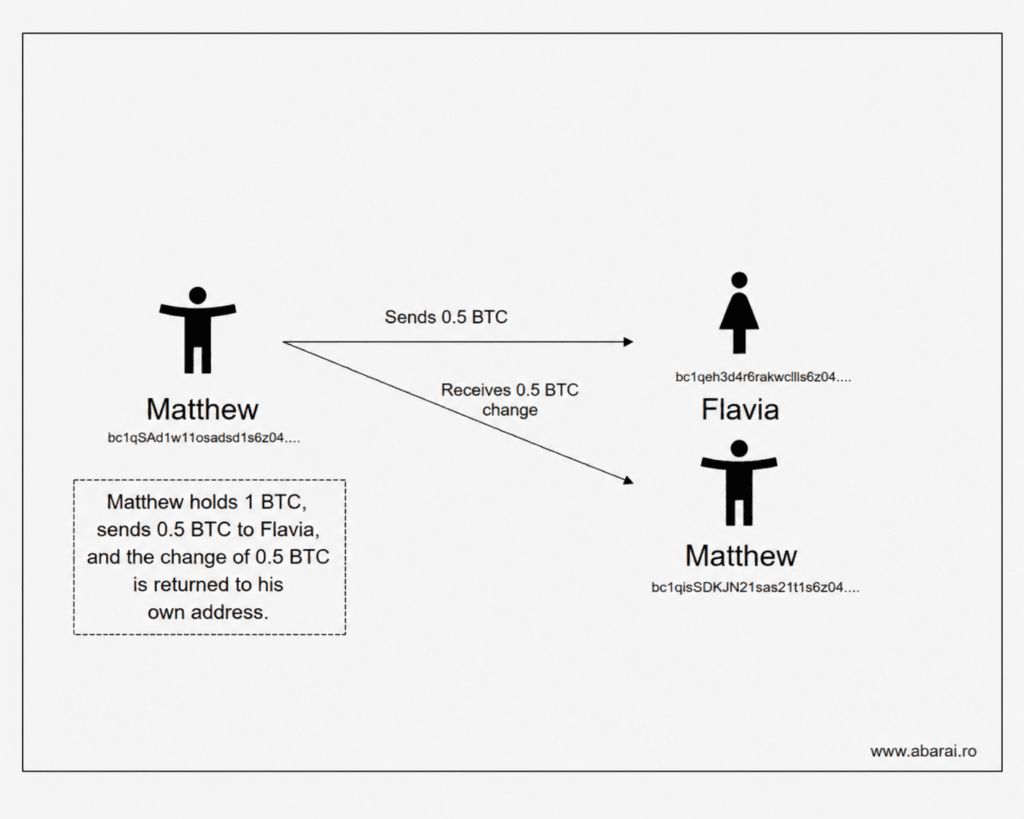
This is one of the Bitcoin concepts that most surprises new users. On Bitcoin, you can’t send exactly an amount from a UTXO — you have to use it all, and the difference automatically returns to you in a new address.
Think of a 100 Euro bill. If you pay for something worth 50 euros, you don’t “cut” the bill — you give 100 euros and receive 50 euros change. On Bitcoin, it works the same way, except the “change” automatically goes to a new address of yours.
Example with Matthew and Flavia
Input: Matthew has 1 BTC in a single UTXO (Unspent Transaction Output)
Wants to send: 0.5 BTC to Flavia
Output 1: 0.5 BTC → Flavia’s address
Output 2: ~0.5 BTC → Matthew’s change address (a new address, still controlled by him)
Fee: A small part of the difference goes to the miners as a processing fee
example of a bitcoin transaction.
The change address is automatically generated by your wallet — you don’t have to do anything manually. Modern wallets create a new address for each transaction, which also improves privacy. All these addresses are derived from the same seed phrase and remain under your complete control.
Remember: If after a transaction you see that the BTC has reached a different address than you expected, don’t panic — first check if that address is still in your wallet. It’s probably the automatically generated change address.
How to verify a Bitcoin address or transaction?
Any transaction on Bitcoin is public and verifiable by anyone. You can use a blockchain explorer — an online tool that shows you the complete history of any address or transaction.
Blockchair
Multi-blockchain, clear interface, supports other networks besides Bitcoin
Mempool.space
Dedicated to Bitcoin, also shows real-time network fee levels
Blockchain.com
One of the oldest Bitcoin explorers, easy to use
Coin.cz
Alternative explorer, useful for quick checks
Enter the address or transaction hash in the search bar of any explorer and you will see: current balance, complete transaction history, number of confirmations, and address type.
Frequently asked questions about Bitcoin addresses
Can I send Bitcoin from a Legacy address to a SegWit address?
Yes. All types of Bitcoin addresses are compatible with each other at the network level — you can send BTC from a Legacy address (1…) to a Native SegWit address (bc1q…) or Taproot (bc1p…) without problems. What matters is that both are on the Bitcoin network, not on another blockchain.
Can a Bitcoin address be changed?
Yes. Modern wallets automatically generate a new address for each received transaction — including for the change address. All these addresses are derived from the same seed phrase and are controlled by you. Old addresses remain valid — you can still receive BTC on them.
Can two people have the same Bitcoin address?
No. Each Bitcoin address is unique and cryptographically generated. The probability of two people generating the same address is practically zero — smaller than the probability of winning the lottery tens of millions of times consecutively. The cryptographic system makes this collision impossible in practice.
Why does my wallet have multiple Bitcoin addresses?
It’s a privacy mechanism. HD (Hierarchical Deterministic) wallets automatically generate a new address for each received transaction and for each change address. All are derived from the same seed phrase — it’s not a problem, but a privacy protection feature.
What happens if I send BTC to a wrong address?
Transactions on the blockchain are irreversible. If the address exists on the Bitcoin network, the BTC will reach there and cannot be recovered — there is no central authority to cancel the transaction. The checksum mechanism protects against typing errors, but not against copying a wrong address. Always check the first and last 6 characters.
What type of address does MetaMask generate?
MetaMask does not generate Bitcoin addresses — it is a wallet for the Ethereum network and ERC-20 tokens. Ethereum addresses start with 0x... and are completely different from Bitcoin addresses. For Bitcoin, you need a dedicated wallet — Muun, BlueWallet, Ledger, or Trezor.
Is Taproot more secure than SegWit?
Not more secure in terms of fund security, but more private and more efficient for complex transactions. Taproot makes multi-signature transactions look identical to simple ones on the blockchain, improving privacy. For the average user buying and storing BTC, the practical difference from Native SegWit is minimal.