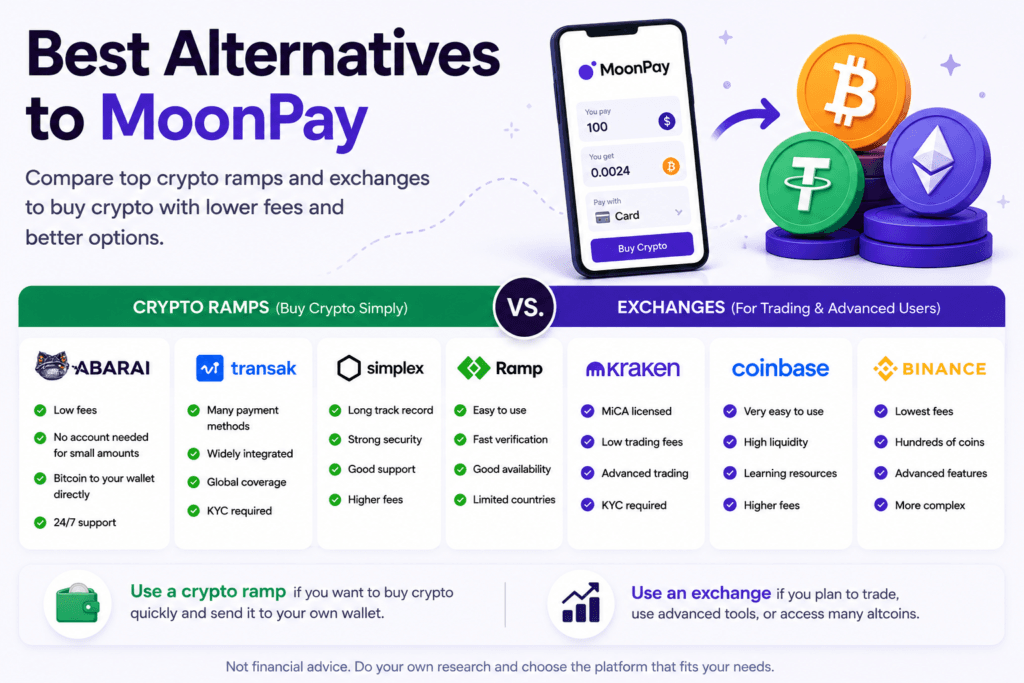
Short Answer
MoonPay is a
crypto ramp — it converts fiat money into
cryptocurrencies and sends them directly to your wallet. The main alternatives are divided into two categories:
other ramps (Abarai, Transak, Simplex, Ramp Network) for simple card purchase, and
exchanges (Kraken, Coinbase, Binance) for active trading. The choice depends on what you want to do with the cryptocurrencies after purchase.
| If you want to… | Platform Type | Examples |
|---|
| Buy crypto quickly with a card, directly into the wallet | Crypto ramp | Abarai, MoonPay, Transak |
| Send crypto to someone in another country | Crypto ramp | Abarai, Ramp Network |
| Engage in active trading with an order book | Exchange | Kraken, Coinbase, Binance |
| Use futures, leverage or margin | Exchange | Kraken, Binance |
| Want access to hundreds of altcoins | Exchange | Binance, Kraken |
What is MoonPay and why people seek alternatives
MoonPay is one of the most well-known crypto ramps in the world — active since 2019, present in over 160 countries, and integrated into hundreds of crypto apps and wallets. When you buy crypto from a wallet like MetaMask or a DeFi app, the “Buy” button often has MoonPay behind it.
As a service, MoonPay does one thing: it converts fiat money (euros, dollars, pounds) into cryptocurrencies and sends them directly to the indicated address. It does not offer trading, does not have an order book, and does not hold user funds.
The reasons users seek alternatives are generally a few:
—High fees. MoonPay charges between 2.9% and 8.9% for card payments, plus network fees. For larger amounts, the difference compared to other platforms becomes significant.
—Limited support. MoonPay offers support via email and chat — no phone, no WhatsApp. If a problem arises with a larger transaction, you wait hours or days for a response.
—Variable availability by country. In some countries or with certain cards, transactions are rejected without a clear explanation.
—Limited coin selection. MoonPay supports a few dozen cryptocurrencies compared to the hundreds available on dedicated exchanges.
Alternative crypto ramps to MoonPay
If you want to buy crypto with a card and send it directly to your wallet — without a trading account, without charts, without advanced features — other ramps are the natural alternative. They work similarly to MoonPay but differ in fees, available countries, and support quality.
Abarai
Abarai is a MiCA-regulated crypto ramp, available in over 160 countries. The process is identical to MoonPay — you enter the amount, the wallet address, pay with a card, and the crypto arrives directly to you.
Compared to MoonPay, Abarai has two concrete differences:
📞 Phone and WhatsApp support+40 731 188 988 — immediate response, no ticket
💰 Competitive feesAmong the lowest fees in the ramp category
Available: globally, 160+ countries · Authorization: MiCA (EU) · Support: phone, WhatsApp, email
Transak
Transak is one of the largest crypto ramps by integration volume — present in over 150 DeFi apps, wallets, and NFT platforms. It supports 170+ cryptocurrencies and is available in 150+ countries.
Fees vary between 1% and 8.5% depending on the payment method and country. Support is via email and chat — no phone.
Available: 150+ countries · Fees: 1-8.5% · Support: email, chat
Simplex (by Nuvei)
Simplex is one of the oldest crypto ramps, active since 2014 and acquired by Nuvei in 2021. It is integrated into dozens of exchanges and wallets — including Binance and Ledger. It processes payments with Visa and Mastercard and supports 150+ cryptocurrencies.
Fees are usually 3.5-9% for cards. Simplex is more of a B2B infrastructure — the end-user experience depends on the platform in which it is integrated.
Available: globally · Fees: 3.5-9% · Support: through host platform
Ramp Network
Ramp Network is a ramp oriented towards DeFi and Web3 applications — integrated into over 400 decentralized applications. It supports payments with card, Apple Pay, Google Pay, and bank transfer in Europe. Available in 150+ countries.
Fees are between 0.9% and 8.9% depending on the payment method — among the most competitive in the category for bank transfers. Support is via email and chat.
Available: 150+ countries · Fees: 0.9-8.9% · Support: email, chat
Crypto ramps comparison — MoonPay vs alternatives
| Platform | Card Fees | Countries | Support | MiCA |
|---|
| MoonPay | 2.9-8.9% | 160+ | Email, chat | Partial |
| Abarai | Competitive | 160+ | Phone, WhatsApp, Email | ✓ Yes |
| Transak | 1-8.5% | 150+ | Email, chat | Partial |
| Simplex | 3.5-8% | Global | Through platform | — |
| Ramp Network | 0.9-8.9% | 150+ | Email, chat | Partial |
What the displayed fees don’t tell you: All ramps also include a spread in the exchange rate — the difference between the market price of the cryptocurrency and the price at which they sell it to you. This spread does not always appear as a separate fee. The best way to compare real: calculate how much cryptocurrency you actually receive for the same amount in euros on each platform.
Exchange alternatives to MoonPay
Exchanges are not direct alternatives to MoonPay in the strict sense — they are different platforms built for a different purpose. An exchange does not replace a ramp, just as a ramp does not replace an exchange. If you want to buy crypto with a card and send it immediately to your wallet, an exchange has too many steps. If you want to trade actively, a ramp does not have the necessary tools.
There is, however, a situation where exchanges appear as an alternative to MoonPay: the user wants to buy crypto, keep it on the platform, and eventually sell or trade it later. In this case, an exchange covers the entire flow in one place — provided you accept that the funds remain in the platform’s custody until you manually withdraw them.
Kraken
Kraken is one of the oldest crypto exchanges in the world, active since 2011 and fully authorized under MiCA regulation in the European Union. It offers spot trading, futures, margin, and staking — with over 750 cryptocurrencies available.
Compared to MoonPay, Kraken is a completely different platform in purpose. It does not send crypto directly to your wallet upon purchase — the funds remain in the Kraken account until you initiate a manual withdrawal. KYC is mandatory before the first transaction.
✓ Fully MiCA authorized in EU✓ Advanced trading — spot, futures, margin✓ 750+ cryptocurrencies✓ Real staking, ~3-15% annually
✗ Full KYC mandatory✗ Custodial funds until withdrawal✗ Complex interface for beginners✗ Does not send directly to wallet
Suitable for: active traders, long-term investors who want staking, advanced users
Coinbase
Coinbase is the most well-known exchange in the USA, listed on the NASDAQ stock exchange since 2021 and regulated in the European Union. It has a simpler interface than Kraken or Binance — closer to a fintech app — making it more accessible for users coming from platforms like Revolut.
Coinbase also offers a separate product called Coinbase Wallet — a non-custodial wallet that operates independently of the exchange account. This is an important distinction: the exchange account is custodial, the separate wallet is not.
✓ NASDAQ listed — financial transparency✓ Intuitive interface for beginners✓ Regulated in EU✓ Separate Coinbase Wallet (non-custodial)
✗ Higher fees compared to Kraken/Binance✗ Full KYC mandatory✗ Custodial funds on exchange✗ Smaller selection compared to Binance
Suitable for: beginners coming from Revolut, users who want an exchange with a solid reputation
Binance
Binance is the largest crypto exchange in the world by trading volume. It offers practically every trading tool available in crypto — spot, futures, margin, P2P, staking, launchpad, lending. With over 350 cryptocurrencies listed and maximum liquidity, it is the choice of active traders who need all the tools in one place.
Binance has had a complicated regulatory path in several European jurisdictions. It is important to check the authorization status for your country before depositing significant funds.
✓ Largest global volume✓ Very low trading fees (0.1%)✓ 350+ cryptocurrencies✓ All trading tools
✗ Overwhelming interface for beginners✗ History of issues with EU regulators✗ Full KYC mandatory✗ Not recommended as the first platform
Suitable for: active traders, high volume, access to all advanced tools
Exchange comparison — Kraken vs Coinbase vs Binance
| Kraken | Coinbase | Binance |
|---|
| Active since | 2011 | 2012 | 2017 |
| Cryptocurrencies | 750+ | 250+ | 350+ |
| Trading fee | 0.16-0.26% | 0.4-0.6% | 0.1% |
| Futures | ✓ | Limited | ✓ |
| MiCA EU | ✓ Fully | ✓ | Partial |
| Ease of use | Medium | High | Low |
| Recommended for | Serious traders, EU | Beginners | Advanced |
Crypto ramp or exchange — what is the real difference
The confusion between ramps and exchanges is common because both allow you to buy cryptocurrencies with fiat money. But the purpose and mode of operation are fundamentally different.
🔄 Crypto ramp
Works like a currency exchange — you give euros, receive crypto directly in your wallet. Funds never remain on the platform.
No trading account, no charts, no order book.
MoonPay, Abarai, Transak, Ramp Network
📊 Exchange
Works like an investment bank — you deposit money, buy and sell on the platform, withdraw manually when you want. Funds are in the custody of the exchange.
Order book, charts, futures, staking, lending.
Kraken, Coinbase, Binance, Bitstamp
| If you want to… | Choose |
|---|
| Buy Bitcoin or USDT with a card, directly into the wallet | Ramp |
| Send crypto to someone in another country | Ramp |
| Buy and hold crypto on the platform, eventually sell | Exchange |
| Engage in active trading with limit or market orders | Exchange |
| Want access to hundreds of altcoins | Exchange |
| Are new to crypto and want simplicity | Ramp |
Many people use both types of platforms in parallel — a ramp for simple card purchases directly into the wallet, and an exchange when they need advanced tools. They are not mutually exclusive options. You can read more about the differences in the article crypto ramp vs exchange.
Common mistakes when choosing an alternative to MoonPay
❌ Comparing a ramp with an exchange as if they are the same
MoonPay and Binance are not direct alternatives — they are different tools for different purposes. If you want to buy €200 in Bitcoin and send it to a friend, Binance involves 6-7 steps and days of waiting for KYC. A ramp does the same thing in 5 minutes.
❌ Looking only at the displayed fee, not the total cost
A platform with a 1% fee but a large spread can cost more than one with a 2.5% fee and a small spread. Always check how much cryptocurrency you actually receive for the entered amount — this is the only correct comparison.
❌ Leaving crypto on the exchange long-term
If you buy crypto on an exchange and do not withdraw it to your own wallet, the exchange holds the
private keys instead of you. The collapse of FTX in 2022 showed that even the largest exchange is not immune to bankruptcy.
⚠️ Choosing a platform without checking authorization
Under MiCA regulation, platforms offering crypto services in the EU must be authorized. Always check that the platform you use operates legally in your country — especially after July 1, 2025.
⚠️ Not checking support before depositing large amounts
If problems arise with a transaction of €500-1000, you want to be able to talk to a person, not wait 48 hours for an email response. Check beforehand what support channels the platform offers — email, live chat, or phone.
Frequently Asked Questions
What is the best alternative to MoonPay?
It depends on what you want to do. For simple card purchase and direct sending to the wallet — any MiCA authorized ramp with transparent fees and accessible support. For active trading with advanced tools — Kraken (fully MiCA) or Coinbase (more accessible for beginners).
Is MoonPay more expensive than the alternatives?
Generally yes — the 2.9-4.9% card fee is among the highest in the ramp category. Ramp Network (0.9-2.9%) and other ramps can be cheaper for the same type of transaction. The correct comparison is made by calculating how much crypto you actually receive for the same amount in euros.
Can I use Kraken or Binance as an alternative to MoonPay?
Technically yes — you can buy crypto on an exchange and then withdraw it to your wallet. But the process involves creating an account, full KYC (1-2 days for the first verification), depositing funds, and only then buying and withdrawing. If you want simplicity and speed, a ramp is much more direct.
What is MiCA and why does it matter?
MiCA (Markets in Crypto-Assets) is the European regulation for crypto platforms, effective from December 2024. MiCA authorized platforms comply with strict requirements for capital, security, and transparency. If a platform operates in the EU without this authorization after July 1, 2025, it is a risk signal.
What is the difference between Transak and MoonPay?
Both are crypto ramps with similar global coverage. Transak supports more payment methods and is more present in DeFi and NFT apps.
MoonPay has a cleaner interface for the end-user and is more recognized as a brand. In terms of fees, they vary depending on the country and payment method — it is worth comparing directly for your specific amount.