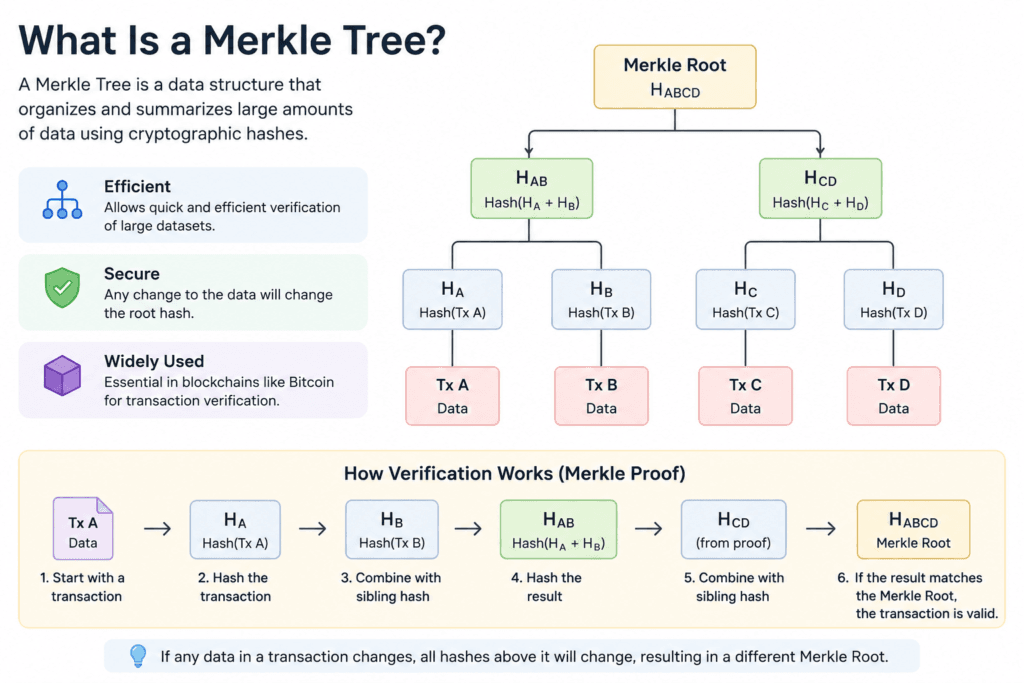
A Merkle tree is a cryptographic data structure that allows efficient verification of any transaction in a block without downloading the entire blockchain. Each transaction is transformed into a hash, hashes are combined in pairs recursively, up to a single root hash — Merkle Root. If any transaction is modified, the Merkle Root changes immediately.
What is the Merkle Tree?
The Merkle tree is a hierarchical data structure invented by computer scientist Ralph Merkle in 1979 — 30 years before Bitcoin. The idea is simple: instead of verifying thousands of transactions one by one, they are cryptographically “summarized” into a single hash representing all the content. Any change in any transaction completely changes the final hash.
what is a Merkle Tree?
Satoshi Nakamoto integrated Merkle trees directly into the architecture of Bitcoin — each block contains a Merkle Root summarizing all transactions in that block. Ethereum extended the concept with Merkle Patricia Tries to store not only transactions but the entire state of the network.
Simple Analogy: Imagine you have a book with 1,000 pages and want to prove that page 537 is authentic without the other person reading the entire book. The Merkle tree allows you to do exactly that — you prove the authenticity of a single page with a “proof” of just a few hashes, instead of 1,000.
How a Merkle Tree Works — Step by Step
Let’s assume a block contains 4 transactions: Tx A, Tx B, Tx C, Tx D. Here’s how the tree is built:
Step 1 — Each transaction is individually hashed
Each transaction passes through the SHA-256 (Bitcoin) or Keccak-256 (Ethereum) function and produces a unique hash. These are the leaves of the tree:Hash(TxA) | Hash(TxB) | Hash(TxC) | Hash(TxD)
Step 2 — Hashes are combined in pairs
Adjacent hashes are concatenated and hashed again:Hash(AB) = Hash(Hash(TxA) + Hash(TxB))Hash(CD) = Hash(Hash(TxC) + Hash(TxD))
Step 3 — The process repeats recursively
Intermediate level hashes are combined again until only one hash remains:Merkle Root = Hash(Hash(AB) + Hash(CD))
Result — Merkle Root in the block header
The final Merkle Root — a single 256-bit hash — is stored in the block header. It represents a cryptographic fingerprint of all transactions in the block. If any transaction changes, the Merkle Root changes completely — and the block becomes invalid.
🌳 Visual Structure of a Merkle Tree with 4 Transactions
[ Merkle Root ]
↙ ↘
[ Hash(AB) ][ Hash(CD) ]
↙ ↘ ↙ ↘
[H(A)][H(B)][H(C)][H(D)]
↑ ↑ ↑ ↑
[TxA][TxB][TxC][TxD]
Transactions → Leaves → Intermediate Nodes → Root
Why the Merkle Tree is Essential for Blockchain
⚡
Efficient Verification
You can verify if a transaction is included in a block with just log₂(n) hashes — not with all n transactions. A block with 1,000 transactions requires only ~10 hashes for verification.
🛡️
Guaranteed Immutability
Any change in any transaction completely changes the Merkle Root — and by extension the block hash. Forgery is detected instantly without comparing each transaction individually.
📱
Light Wallets (SPV)
Simplified Payment Verification allows mobile applications to verify transactions by downloading only block headers (~80 bytes/block) and a “Merkle proof” — not the entire blockchain of hundreds of GB.
🔗
Scalability
Merkle trees are the foundation of scalability solutions like Layer 2 and rollups — allowing off-chain processing with compact cryptographic proofs on the main chain.
💾
Storage Efficiency
Nodes do not need to store all transactions to validate a block — they can operate with just the Merkle Root. This dramatically reduces storage requirements for light nodes.
🔍
Merkle Proof
You can prove that a transaction is included in a block without revealing the other transactions — useful for privacy and selective data verification.
What is a Merkle Proof and How it Works
A Merkle Proof is a minimal set of hashes that demonstrates a specific transaction is included in the tree — without revealing the other transactions.
📝 Example: Proving TxC is in the Block
You need: Hash(TxD) and Hash(AB)Process:1. Calculate Hash(TxC) — you know the transaction2. Combine with Hash(TxD) → obtain Hash(CD)3. Combine with Hash(AB) → obtain Merkle Root4. Compare with the Merkle Root in the block headerIf they match, TxC is certainly in the block. You used only 2 hashes — not all 4 transactions.
Why does this matter practically? A Bitcoin block contains on average 2,000–3,000 transactions. To verify a single transaction without a Merkle Proof, you would have to download all transactions (~1-2 MB). With a Merkle Proof, you need only 11-12 hashes (~400 bytes). 5,000x more efficient. This makes mobile crypto applications possible that cannot download the entire blockchain.
Merkle Trees in Different Blockchain Networks
₿ Bitcoin — Classic Merkle Tree
Each Bitcoin block contains a single Merkle Tree of transactions. The Merkle Root is included in the block header along with the previous block hash, timestamp, and nonce. Used by Satoshi from day 1, in 2009. Hash function: SHA-256 applied twice (SHA256d).
⟠ Ethereum — Merkle Patricia Trie (MPT)
Ethereum uses an extended variant — Merkle Patricia Tries — to store not only transactions but also the complete state of the network (balances, smart contract code, storage). Each block contains three separate Merkle roots: State Root, Transaction Root, and Receipt Root. Hash function: Keccak-256.
🔵 Layer 2 and Rollups — Merkle for Scalability
Layer 2 solutions process thousands of transactions off-chain and “compress” them into a single Merkle Root published on the main chain. A dishonest operator trying to publish a false root can be proven wrong with a Merkle Proof — without rechecking all transactions.
With and Without Merkle Tree — What Difference It Makes
❌ Without Merkle Tree
✅ With Merkle Tree
Transaction Verification
Download all transactions in the block
Only log₂(n) hashes
Data Required (3,000 tx)
~1.5 MB
~400 bytes
Forgery Detection
Compare each transaction
Single Merkle Root comparison
Mobile Wallets
Impossible — too much data
Possible via SPV
L2 Scalability
Impossible efficiently
Rollups, fraud proofs
Frequently Asked Questions About Merkle Tree
What is a Merkle Tree?
A Merkle tree is a cryptographic data structure where each data element is hashed, hashes are combined in pairs recursively up to a single root hash (Merkle Root). It allows efficient verification and detection of any changes in the data.
What is Merkle Root?
Merkle Root is the final hash at the top of the tree — a unique 256-bit fingerprint representing all transactions in a block. It is stored in the block header. If any transaction changes, the Merkle Root changes completely.
Why does Bitcoin use Merkle Trees?
Bitcoin uses Merkle trees to allow quick verification of transactions without downloading the entire blockchain. Mobile applications can verify if a payment has been confirmed by downloading only block headers and a compact Merkle Proof.
What is SPV (Simplified Payment Verification)?
SPV is a method of verifying transactions described by Satoshi Nakamoto in the Bitcoin whitepaper. Using Merkle trees, a resource-limited device (mobile phone) can verify that a transaction is included in a block by downloading only the block header and a few hashes — not the entire blockchain.
How does Merkle Patricia Trie differ from a classic Merkle Tree?
A classic Merkle tree (used by Bitcoin) stores only a list of transactions. Merkle Patricia Trie (used by Ethereum) combines the properties of a Merkle tree with a trie (prefix tree) — allowing efficient storage and access to arbitrary key-value pairs. This makes it possible to store the entire state of the Ethereum network (balances, contract codes) in a verifiable manner.
Are Merkle Trees used only in crypto?
No — Merkle trees are also used in distributed file systems (IPFS, Git), peer-to-peer protocols (BitTorrent), SSL/TLS certificate systems, and distributed databases. Blockchain popularized the concept, but it has existed since 1979.