Peer-to-Peer (P2P) is a system where two people trade or communicate directly with each other, without a central intermediary like a bank. In crypto, P2P is the foundation of blockchain networks and platforms where users buy and sell cryptocurrencies directly with each other.
What does Peer-to-Peer (P2P) mean?
Peer-to-Peer (P2P) represents a decentralized system where participants interact directly with each other, without relying on a central authority or intermediary.
In the cryptocurrency industry, peer-to-peer transactions allow users to buy, sell, or transfer digital assets directly with each other. Instead of a traditional financial institution, the exchange is made between two people connected through a network or platform.
Where does the term Peer-to-Peer come from?
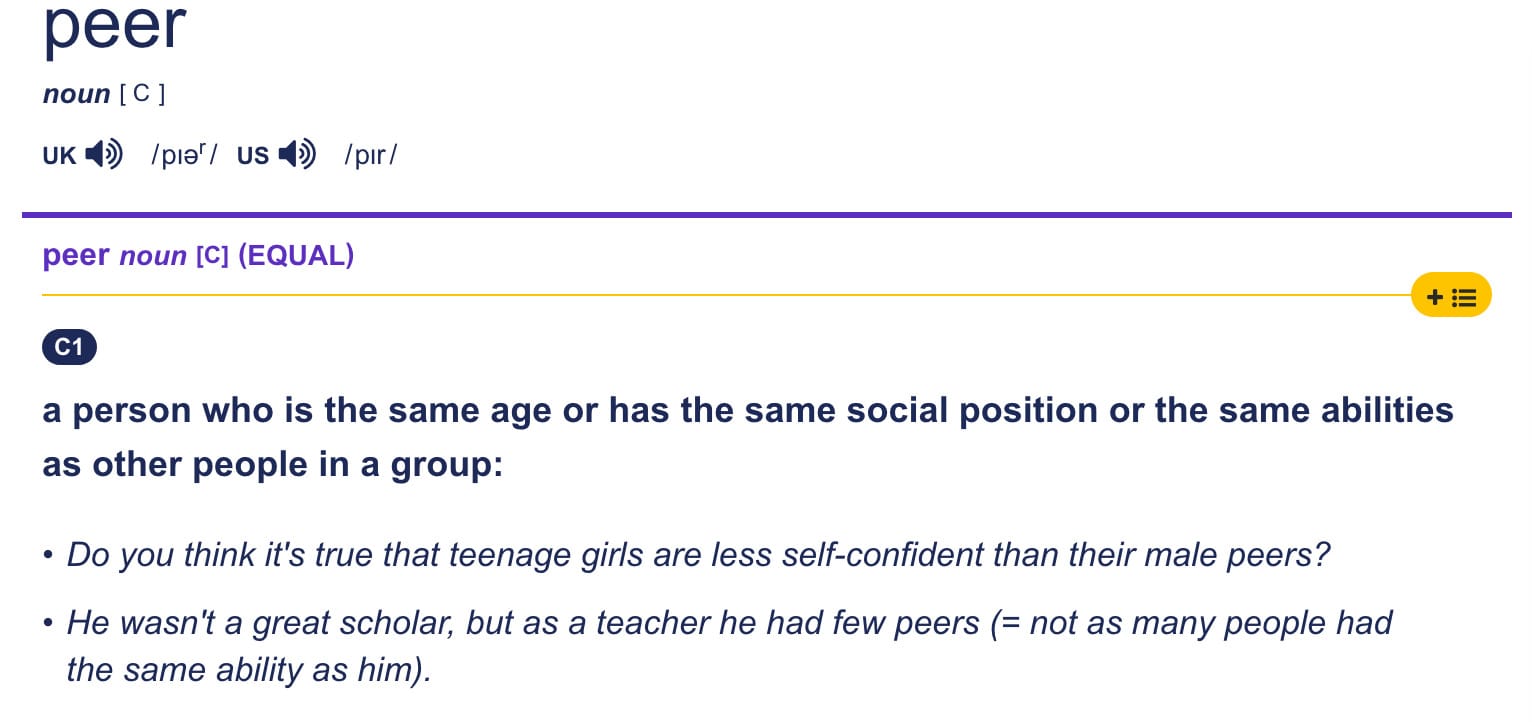
The word “peer” means “equal” or “pair” in English. In a peer-to-peer network, each participant has the same role and level of authority — there is no central server dictating rules or controlling the flow of information.
Definition of the word “peer” in English. Source: Cambridge Dictionary.
The concept emerged in computer science in the 1960s–70s, but gained wide notoriety with the launch of Napster in 1999 — the first major platform for sharing music files through P2P networks. The idea has evolved significantly, becoming the foundation of Bitcoin and the entire crypto industry.
How does Peer-to-Peer work?
In a peer-to-peer network, each participant can act as both a user and a resource provider. When two people make a transaction, they communicate directly, without needing a central server to process the exchange.
Traditional System vs. Peer-to-Peer
❌ Traditional System
User A
↓
Bank / Intermediary
↓
User B
✓ Peer-to-Peer
User A
⟷
User B
No intermediary
In the case of crypto P2P platforms, services such as escrow, reputation systems, and dispute resolution mechanisms are frequently used to increase transaction safety.
Practical example — how P2P works in Bitcoin
Ana wants to send David 0.01 BTC. Here’s what happens:
Ana initiates the transaction from her wallet and signs with her private key
↓ broadcast to the network
Nodes of the Bitcoin network verify the transaction and propagate it
One of the most common confusions: many believe P2P = blockchain. This is not true. Blockchain is just one of the applications of P2P networks.
🎵
BitTorrent
P2P file sharing — no blockchain
📞
Skype (old version)
Direct P2P calls — no blockchain
₿
Bitcoin
P2P network + blockchain
In short: Any blockchain uses a P2P architecture, but not every P2P network is a blockchain. P2P is the architecture; blockchain is a specific application of it.
When someone searches for “P2P crypto”, it can refer to two completely different things. It’s important to distinguish them:
🌐 P2P Network
Technical architecture of the blockchain
Nodes communicate directly with each other
Example: Bitcoin network
💱 P2P Trading
Platforms where users buy/sell directly with each other
There is a partial intermediary (platform + escrow)
Example: Binance P2P, LocalBitcoins
On Binance P2P, for example, you do not buy from Binance — you buy from another user. Binance only acts as a mediator providing the escrow service and reputation system. Funds are transferred directly between users.
Peer-to-Peer in cryptocurrencies
Peer-to-peer systems are one of the foundations of blockchain technology. Bitcoin was even described in its original white paper as “a peer-to-peer electronic cash system” — a system where values can be transferred directly between participants without a central authority.
P2P trading platforms allow users to exchange cryptocurrencies using payment methods such as:
Bank transfer;
Cash deposit;
Mobile payment apps;
Digital wallets;
Other local payment methods.
Why is Peer-to-Peer important?
P2P is not just a technical detail — it is a fundamental change in how values and information circulate:
Eliminates single points of failure
In a centralized network, if the server goes down, everything goes down. In a P2P network, thousands of independent nodes keep the network functional even if some disappear.
Censorship resistance
No entity can unilaterally block transactions. There is no single point to stop to halt the network.
Enables blockchains without central authority
Bitcoin, Ethereum, and other blockchains work precisely because they use P2P architecture — no company or government controls them.
Facilitates global value transfers
You can send Bitcoin to Australia as easily as to the next city — without international bank fees, without waiting days, without approvals.
Advantages and disadvantages of Peer-to-Peer systems
✓Check the reputation and history of the trading partner
✓Use escrow services when available
✓Confirm receipt of payment before releasing funds
✓Do not share sensitive personal information
✓Store your seed phrase offline and do not share it with anyone
Frequently Asked Questions
What does P2P mean?
P2P stands for Peer-to-Peer and describes a system where participants interact directly with each other, without intermediaries. The word “peer” means “equal” — all participants have the same role in the network.
Is Bitcoin a Peer-to-Peer network?
Yes. Bitcoin was created as a peer-to-peer electronic cash system that allows direct value transfer between users, without banks or intermediaries. Satoshi Nakamoto’s 2008 white paper is even titled “Bitcoin: A Peer-to-Peer Electronic Cash System”.
Are P2P transactions safe?
They can be safe when conducted through trusted platforms that offer escrow services and reputation systems. At the blockchain network level, P2P transactions are cryptographically secured. At the P2P trading level, human risk remains — always verify the partner.
Do I need a bank for Peer-to-Peer transactions?
No. P2P transactions with cryptocurrencies can be completed entirely without the involvement of a bank. You only need a wallet, the recipient’s address, and funds in the network.
What is the difference between a node and a P2P participant?
A node is a computer that actively participates in the network — it verifies, stores, and propagates transactions. A P2P participant can be any user who sends or receives value in the network, even if they do not run a full node.