
In brief:
- CARF is an international standard for reporting crypto-asset transactions.
- It was developed by OECD to increase tax transparency.
- It allows the exchange of information between tax authorities in different countries.
- DAC8 is the European version partially inspired by CARF principles.

How does CARF work ?
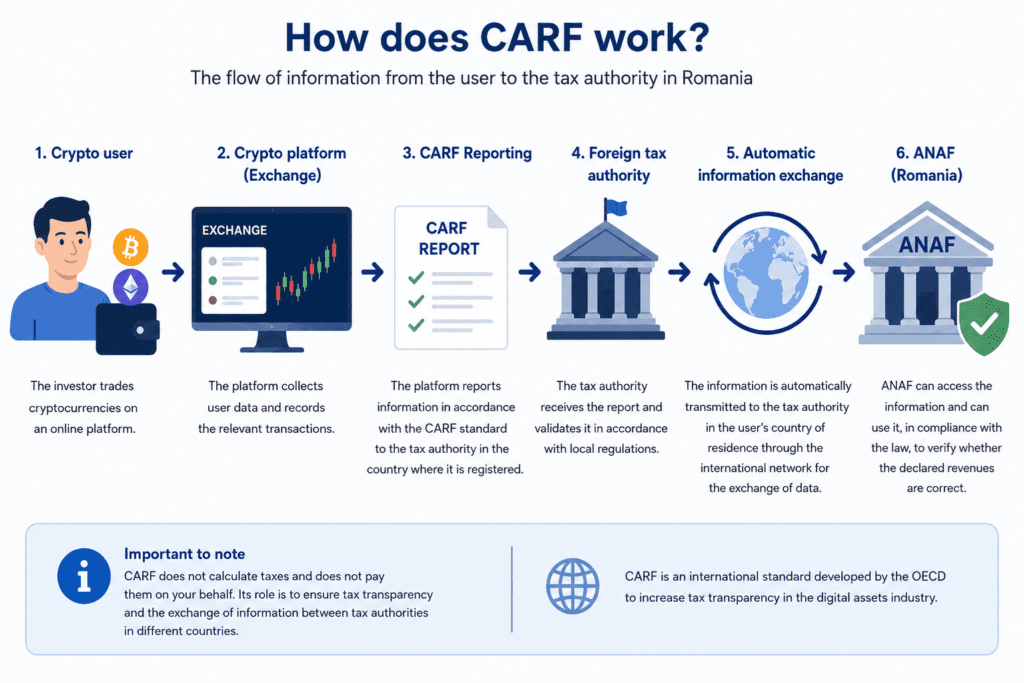
CARF (Crypto-Asset Reporting Framework) is an international reporting standard created by the Organisation for Economic Co-operation and Development (OECD) to improve tax transparency in the digital asset industry.
The main purpose of CARF is to enable tax authorities to obtain relevant information about certain cryptocurrency transactions and to facilitate the exchange of this information between countries.
As the use of cryptocurrencies has increased globally, tax authorities have noticed that traditional reporting systems do not effectively cover digital assets. CARF was created to fill this gap.
What does CARF mean?
CARF is the acronym for Crypto-Asset Reporting Framework.
In loose translation, the term can be understood as an international framework for reporting digital assets.
This standard establishes what information should be collected and reported by certain companies facilitating transactions with crypto-assets.
Why was CARF created?
In recent years, cryptocurrencies have become increasingly popular, and digital asset transfers can occur quickly between users in different jurisdictions.
Tax authorities have found that this evolution makes it more difficult to identify and verify certain income obtained from crypto-assets.
For this reason, the OECD developed CARF to create a common standard that allows reporting and information exchange between states.
The main objective is to increase tax transparency and adapt existing rules to the digital economy.
How does CARF work?
CARF establishes a set of rules regarding the collection and reporting of certain information about crypto-asset transactions.
Companies targeted by these rules may be required to collect information about users and certain transactions conducted through their platforms.
The reported information can then be transmitted to tax authorities and exchanged between participating states.
In practice, CARF operates similarly to other international automatic information exchange systems already used in the traditional financial sector.
Concrete example
You are a tax resident in Romania and trade cryptocurrencies on an international platform that falls under CARF rules. The platform collects your identification data and records relevant transactions.
This information may be reported to the tax authority in the country where the platform operates and, through the automatic information exchange mechanism, may reach ANAF.
CARF does not calculate the taxes you owe and does not pay them on your behalf. Its role is to ensure that tax authorities have access to the necessary information to verify if you declare your income correctly.
What information can be reported through CARF?
The exact information depends on the implementation of the rules in each jurisdiction, but the CARF framework is designed to allow the reporting of certain activities and transactions involving crypto-assets.
- user identification data
- country of tax residence
- certain transactions with crypto-assets
- transfers and conversions between different digital assets
- other information necessary for the application of tax rules
The aim is not to monitor every individual activity but to create a standardized mechanism through which tax authorities can obtain relevant information when needed.
CARF and cryptocurrencies
CARF was specifically created for the digital asset industry and aims to provide tax authorities with a common reporting framework for crypto-asset transactions.
By introducing an international standard, OECD aims to facilitate cooperation between states and reduce differences between the tax treatment of digital assets and that applicable to other financial instruments.
CARF vs DAC8
CARF and DAC8 are closely related, but they are not the same thing.
| CARF | DAC8 |
|---|---|
| International standard developed by OECD | European Union directive |
| Applies globally | Applies in the European Union |
| Defines the reporting framework | Transposes reporting principles into European legislation |
| Promoted by OECD | Adopted by EU institutions |
In short, CARF represents the international framework that inspired some of the new tax reporting rules applicable to digital assets, while DAC8 represents the European implementation of similar principles.
If you want to better understand how DAC8 works in Romania, you can consult our guide on what DAC8 is.
CARF and Travel Rule
CARF and Travel Rule are two different standards targeting the crypto industry, but they pursue distinct objectives.
CARF focuses on tax reporting and information exchange between tax authorities, while Travel Rule aims to identify the sender and recipient in digital asset transfers as a measure to combat money laundering.
In practice, crypto platforms may need to comply with both sets of rules simultaneously.
How does CARF affect ordinary users?
For most users, CARF operates in the background and is implemented through crypto platforms targeted by the reporting rules.
Users do not need to send information directly to OECD. Instead, certain data may be collected by the platforms used and reported according to applicable legal obligations.
CARF does not introduce new taxes and does not change how cryptocurrencies operate. Its main role is to increase international tax transparency.
Frequently Asked Questions
What is CARF?
CARF (Crypto-Asset Reporting Framework) is an international reporting standard developed by OECD to improve tax transparency in the digital asset industry.
Is CARF a tax?
No. CARF does not introduce new taxes and does not set tax rates. It is a reporting framework used for the exchange of information between tax authorities.
Is CARF the same as DAC8?
No. CARF is an international standard created by OECD, while DAC8 is a European directive on the tax reporting of digital assets.
Does CARF apply to cryptocurrencies?
Yes. CARF was specifically designed to address the tax challenges posed by the use of cryptocurrencies and other digital assets.
Can ANAF receive information through CARF?
Yes. CARF is designed to facilitate the exchange of information between tax authorities in different states. In certain situations, information reported by crypto platforms may also reach the tax authority in the user’s country of residence.
Do I need to report information to CARF?
No. Generally, the reporting obligations fall on service providers and platforms targeted by the relevant rules.
Conclusion
CARF is an international standard developed by OECD for reporting certain transactions with crypto-assets and exchanging information between tax authorities.
Although users rarely interact directly with this system, CARF underpins many modern tax transparency initiatives, including some rules later implemented through DAC8 in the European Union.