

In short:
- DAC8 is the European directive that introduces crypto transaction reporting to tax authorities.
- It does not introduce new taxes for cryptocurrencies and does not change existing tax levels.
- Reporting obligations fall on crypto platforms and service providers, not users.
- Reported information can be automatically exchanged between tax authorities in EU member states.
- DAC8 and MiCA are different regulations: DAC8 deals with tax reporting, while MiCA regulates the crypto market.
The cryptocurrency market has grown rapidly in recent years, and tax authorities worldwide have tried to adapt existing rules to the realities of the digital economy.
While the traditional banking system benefits from systems through which banks transmit data to tax authorities, digital assets have long operated in an environment with a lower level of tax transparency.
To reduce this gap, the European Union adopted DAC8, a directive that extends tax reporting rules to certain activities conducted through crypto platforms.
This guide explains what DAC8 is, why it was created, how reporting works, what information can be transmitted to tax authorities, and what impact it may have on cryptocurrency investors in the European Union.
What is DAC8?
DAC8 represents the latest update to the Directive on Administrative Cooperation in the tax field.
According to the directive adopted by the European Union, targeted crypto platforms must collect and report certain information about users and their transactions to the competent tax authorities.
Before DAC8, tax authorities often had limited access to information about activities conducted on crypto platforms, especially when they operated in other jurisdictions.
DAC8 seeks to reduce this deficit by introducing a European reporting framework for activities conducted through crypto platforms.
DAC8 vs MiCA: What is the difference?
Many investors confuse DAC8 and MiCA because both regulations were developed in the same period and target the digital asset industry. In reality, the two legislative acts operate in parallel and address different issues.
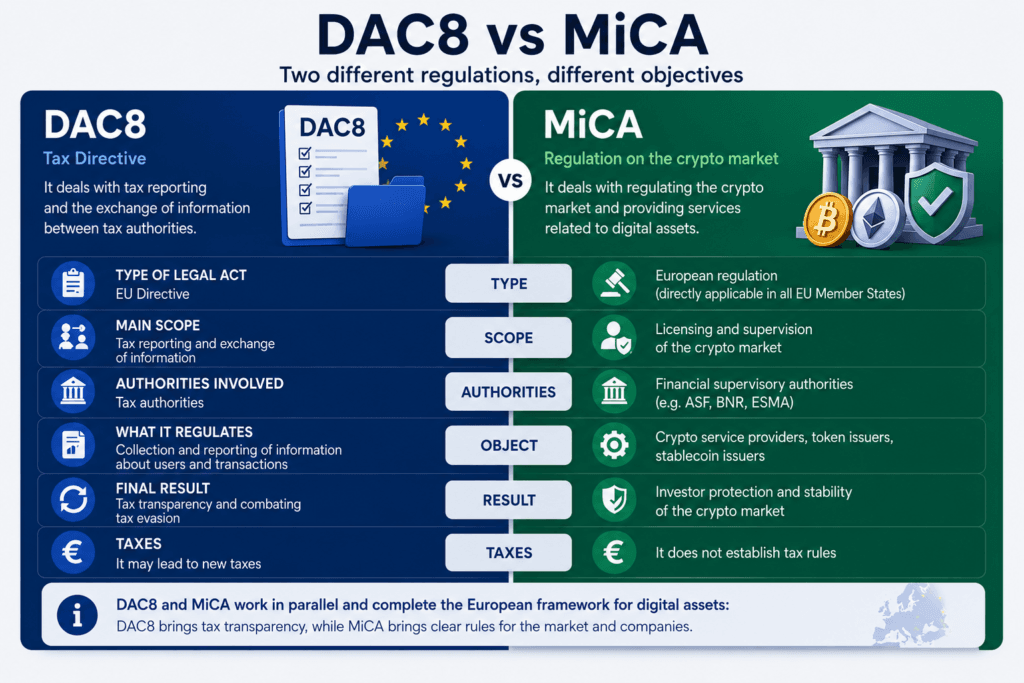
| DAC8 | MiCA |
|---|---|
| Tax directive | Crypto market regulation |
| Reporting and information exchange | Licensing and supervision |
| Tax authorities | Financial supervisory authorities |
| Tax transparency | Investor protection |
| Collection of transaction information | Regulation of crypto service providers |
| Does not introduce new taxes | Does not establish tax rules |
Why was DAC8 created?
In the last decade, the cryptocurrency market has grown from a niche sector to a global industry with millions of users and assets valued at hundreds of billions of euros.
As adoption increased, tax authorities noticed that many traditional reporting mechanisms were not adapted for digital assets.
According to the European Commission, the goal of DAC8 is to reduce the lack of information in the digital asset sector and create a level of transparency comparable to that existing in the traditional financial sector.
In the traditional financial system, banks and financial institutions already transmit certain information to tax authorities through various international cooperation systems.
In the case of cryptocurrencies, however, users could hold accounts on platforms in other jurisdictions and conduct activities without relevant information automatically reaching the tax authorities in their country of residence.
This does not mean that crypto transactions were anonymous or impossible to track. Public blockchains are transparent by definition. The problem was the lack of a standardized tax reporting system.
Objectives of DAC8
Through DAC8, the European Union aims to:
- combat tax evasion in the digital asset sector
- increase transparency of crypto transactions
- standardize reporting rules at the European level
- facilitate automatic information exchange between tax authorities
- adapt tax legislation to the digital economy
Link between DAC8 and OECD CARF standard
DAC8 was not created in isolation. The directive is closely linked to the Crypto-Asset Reporting Framework (CARF), the international standard developed by the OECD for reporting digital assets.
CARF aims to create a standardized framework through which tax authorities in different countries can collect and exchange information about digital asset transactions.
The European Union has adopted many of the principles of this standard and integrated them into European legislation through DAC8.
How does DAC8 work?
The mechanism is similar to existing reporting systems in the banking and financial sector.
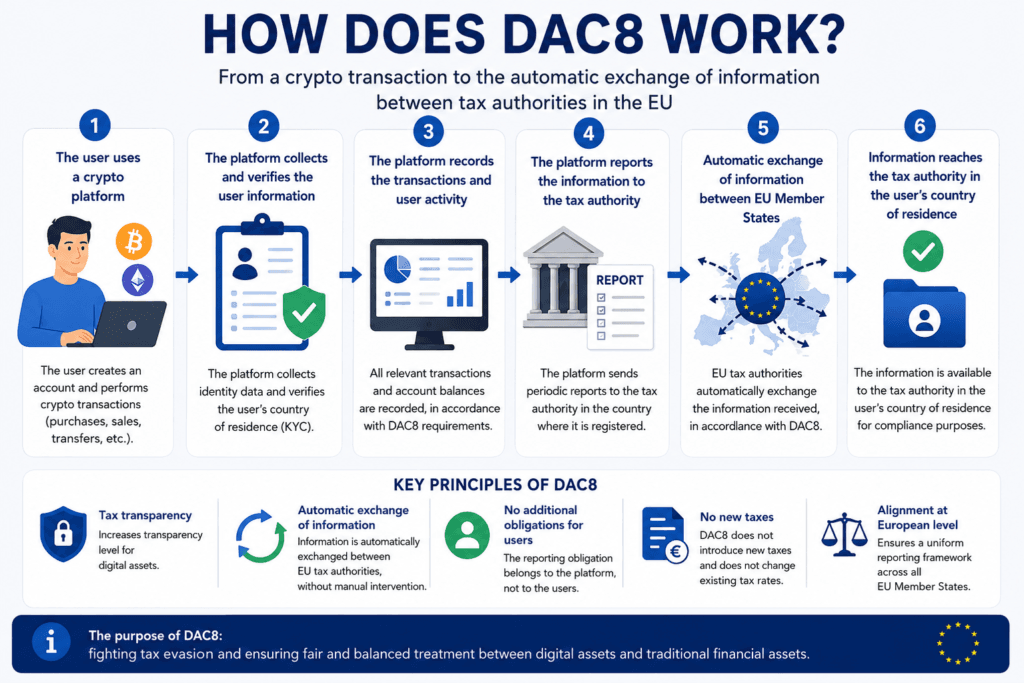
- The user creates an account on a crypto platform.
- The platform collects identification information and establishes tax residence.
- The platform records the user’s activity.
- Relevant information is reported to the competent tax authority.
- Tax authorities in the European Union automatically exchange this information.
- Data reaches the tax authority in the user’s country of residence.
What information is reported through DAC8?
According to the text of the directive, reported information may include both identification data and information about activity conducted on the platform.
User data
- first and last name
- address
- date of birth
- tax residence
- tax identification number (TIN) — for Romanian citizens, this is the CNP
Examples of activities that can be reported
| Activity | Can be reported? |
|---|---|
| Buying crypto with euros or lei | Yes |
| Selling crypto for fiat | Yes |
| Exchange BTC → ETH | Yes |
| Exchange ETH → USDT | Yes |
| Transfers made through the platform | Yes |
The purpose of DAC8 is not to automatically calculate taxes owed by users but to provide the necessary information to tax authorities for verifying existing tax obligations.
What is NOT reported through DAC8?
After the appearance of DAC8, many investors assumed that tax authorities would have direct access to all activities conducted on the blockchain. In reality, the directive works differently.
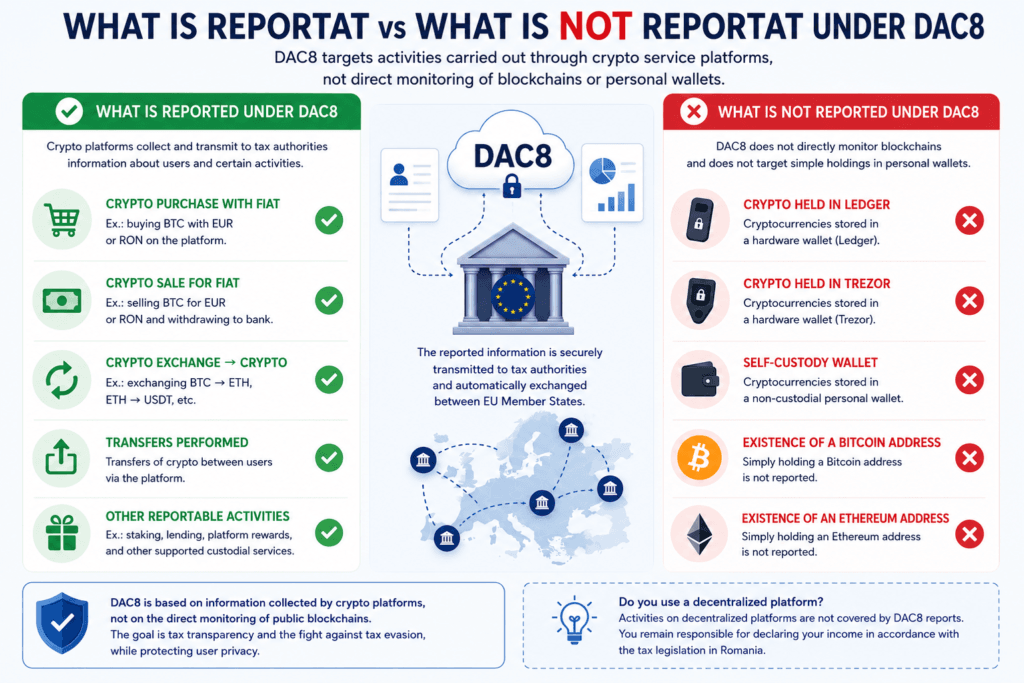
Examples of activities not reported directly through DAC8
| Situation | Reported directly through DAC8? |
|---|---|
| Holding cryptocurrencies in a Ledger | No |
| Holding cryptocurrencies in a Trezor | No |
| Storing assets in a self-custody wallet | No |
| Existence of a Bitcoin address | No |
| Existence of an Ethereum address | No |
DAC8 does not monitor the Bitcoin blockchain
Public blockchains are transparent by nature, but DAC8 does not represent a European mechanism for monitoring blockchains.
The directive relies on information collected by crypto platforms and on the automatic exchange of information between tax authorities. In other words, DAC8 does not “read” the Bitcoin blockchain and does not directly track every transaction made between private wallets.
For more details about hardware wallets and self-custody wallets, see the section below.
Who does DAC8 apply to?
DAC8 does not directly apply to individual investors but to crypto platforms that facilitate transactions or offer services related to digital assets.
According to the directive, reporting obligations fall on companies that fall into the category of crypto service providers and offer services to users in the European Union.
Examples of entities that may be targeted by DAC8
- centralized exchanges
- crypto trading platforms
- digital asset brokers
- certain custody services
- other companies facilitating crypto transactions
DAC8 and Binance
In practice, DAC8 does not exclusively target Binance. The rules are designed to apply to crypto platforms that fall within the scope of the directive and offer services to users in the European Union.
The same principle applies to other popular platforms such as Coinbase, Kraken, Abarai or Bitstamp, or other crypto services operating in the European market.
Does this mean Binance automatically transmits taxes to ANAF?
No.
DAC8 does not introduce a mechanism by which platforms calculate and automatically pay taxes on behalf of users. The role of the directive is to facilitate reporting and information exchange between tax authorities.
The obligation to declare and pay any taxes remains the responsibility of the taxpayer, according to the applicable tax legislation in their country of residence.
Will ANAF find out about my cryptocurrencies?
This is probably the most common question from crypto investors when they first hear about DAC8.
The short answer is that DAC8 was designed precisely to facilitate information exchange between European tax authorities.
If a crypto platform reports information in accordance with DAC8, it can be transmitted through tax cooperation systems to the competent tax authority in the user’s country of residence.
However, it is important to understand that DAC8 does not create new tax obligations and does not change existing rules regarding the declaration of cryptocurrency income.
Concrete example: what happens if you bought €1,000 BTC on Binance
You are a tax resident in Romania and bought Bitcoin worth €1,000 on Binance in 2026. Later, you sold that Bitcoin for a profit of €300.
What happens from the perspective of DAC8:
- Binance collects your identification data and National tax residence at the time of registration.
- Binance records your transactions — buying and selling Bitcoin.
- Binance reports this information to the tax authority in the country where it operates.
- Through the European automatic information exchange system, the data reaches Financial Authorities in 2027.
- Financial Authorities from your country can verify if you correctly declared the €300 profit in your tax return.
What DAC8 does NOT do in this example:
- It does not automatically calculate the tax you owe — but you can use our crypto tax calculator to find out exactly what you owe.
- It does not pay the tax on your behalf.
- It does not block the transaction.
The obligation to declare the €300 profit and pay the corresponding tax remains yours, according to Romanian tax legislation. DAC8 only makes it easier for National authorities to verify if you have done so.
DAC8 Europe: What European investors need to know
For investors in Europe, DAC8 has some specific practical implications.
What changes for European users?
- National Authorities can receive information about activity conducted on certain crypto platforms.
- The declaration of crypto income remains the responsibility of the taxpayer.
- DAC8 does not change existing crypto taxes.
- The use of centralized platforms becomes more transparent from a tax perspective.
- If you use centralized platforms like Binance, Coinbase, Abarai or Kraken, you should assume that information about your transactions may reach National Authorities starting in 2027, when automatic information exchange is scheduled to begin.
- If you have not declared your crypto income, DAC8 significantly reduces the possibility that it will remain undetected by tax authorities.
Ledger, Trezor, and self-custody wallets
Many users choose to keep their cryptocurrencies in personal wallets like Ledger or Trezor to have direct control over private keys and reduce dependence on centralized platforms.
Unlike a centralized exchange, a hardware wallet does not act as an intermediary between the user and the blockchain and does not normally collect information about the user’s financial activity.
For this reason, simply holding cryptocurrencies in a Ledger or Trezor does not represent an activity directly reported through DAC8.
However, in practice, many transactions involve transfers between personal wallets and centralized platforms. In such situations, certain information may become available to platforms that fall under reporting obligations.
DeFi and decentralized exchanges (DEX)
One of the most complex questions regarding DAC8 is how the directive may affect the DeFi (Decentralized Finance) ecosystem and decentralized exchanges.
How DeFi works compared to centralized platforms
Centralized platforms like Binance or Coinbase have a clearly identifiable operator, collect KYC data, and can be subject to reporting obligations directly.
DeFi protocols work differently — they run on autonomous smart contracts, without a centralized operator controlling the funds or performing identification procedures. Examples of targeted DeFi activities: trading on DEXs (Uniswap, dYdX), providing liquidity, lending on Aave or Compound, staking on decentralized protocols.
Why applying DAC8 in DeFi is more complex
The absence of a centralized intermediary makes it more difficult to apply reporting rules. There is no operator to collect KYC data and report it to tax authorities.
Does this mean DeFi is completely outside DAC8?
Not necessarily. The fact that a protocol is decentralized does not automatically mean that activities conducted through it are excluded from tax regulations. As European legislation evolves, certain DeFi services with an identifiable operator may fall under additional compliance requirements.
Additionally, users transferring funds between centralized platforms and DeFi protocols may generate information that becomes visible through platforms subject to reporting obligations.
How are crypto platforms preparing for DAC8?
The new reporting obligations come into effect in 2026, and crypto platforms targeted by the directive must be prepared.
What platforms need to do
KYC data collection — Platforms must ensure they have complete and up-to-date information about their users: name, address, tax residence, tax identification number. Many operators have already intensified their identity verification processes.
Reporting systems — Platforms must build or adapt technical systems that allow the collection, structuring, and transmission of relevant data to tax authorities in the format required by DAC8.
Identifying tax residences — DAC8 requires platforms to determine users’ tax residence, not just nationality or domicile address. This can be challenging for users with multiple or changing tax residences.
Compliance costs — Implementing all these requirements involves significant investments in technology and human resources, especially for smaller platforms.
What this means for users
If you use a crypto platform and have not gone through a complete identity verification process, you may receive additional requests from the platform in the coming period — precisely to comply with DAC8 requirements.
Updating tax residence data on the platforms you use becomes increasingly important, especially if you have changed your country of residence in recent years.
Does DAC8 introduce new taxes for cryptocurrencies?
One of the most widespread misconceptions is that DAC8 represents a new tax on cr. In reality, the directive does not establish tax rates and does not change national tax legislation regarding digital assets.
The role of DAC8 is to create a reporting and information exchange system between tax authorities. If a certain income was taxable before DAC8, it remains taxable after the directive comes into effect. The difference is that tax authorities can more easily access the information needed to verify existing tax obligations.
Should you be concerned about DAC8?
DAC8 does not prohibit the use of cryptocurrencies and does not limit the right of individuals to buy, hold, or trade digital assets. The objective of the directive is to increase tax transparency and improve information exchange between European tax authorities.
If you declare your income
For those who declare and correctly tax their cryptocurrency income, DAC8 changes very little in practice. Existing tax obligations remain the same, and the directive does not introduce new categories of taxes.
If you use centralized platforms
Users of centralized platforms should assume that relevant information about their activity may be reported under the European tax cooperation framework — similar to how reporting already works in many segments of the traditional financial system.
If you use DeFi and personal wallets
The situation may be more complex, as the DeFi ecosystem and self-custody services operate differently from centralized platforms. However, using a personal wallet does not automatically eliminate tax obligations that may exist under applicable legislation in the user’s country of residence.
Advantages and criticisms of DAC8
Possible advantages of DAC8
- increased tax transparency
- combating tax evasion
- standardizing reporting rules at the European level
- improving cooperation between tax authorities
- creating a clearer framework for the crypto industry
Main criticisms
- additional costs for crypto platforms
- more complex administrative obligations
- uncertainties regarding the application of certain rules in the DeFi ecosystem
- risks related to the protection and management of reported data
When does DAC8 come into effect?
DAC8 was officially adopted by the European Union in 2023, but practical implementation is phased.
According to the Council of the European Union, the new reporting rules will start to apply from 2026, and automatic information exchange between tax authorities is scheduled to begin in 2027.
These deadlines may vary depending on practical implementation and measures adopted by each member state.
Frequently asked questions about DAC8
What is DAC8?
DAC8 is a European directive that introduces reporting obligations for certain activities conducted through crypto platforms and facilitates information exchange between tax authorities.
Does DAC8 introduce new taxes for cryptocurrencies?
No. DAC8 does not establish tax rates and does not introduce new taxes. The directive aims to improve reporting and tax cooperation between member states.
Are DAC8 and MiCA the same thing?
No. MiCA regulates the crypto market and service providers, while DAC8 focuses on tax reporting and information exchange between tax authorities.
Will ANAF find out about my cryptocurrencies?
DAC8 was designed to facilitate information exchange between European tax authorities. In certain situations, information reported by crypto platforms may reach the tax authority in the user’s country of residence.
Does Binance report information under DAC8?
DAC8 does not target a single platform. Reporting obligations apply to crypto platforms that fall within the scope of the directive and offer services to users in the European Union.
Does DAC8 apply to Ledger and Trezor wallets?
Simply holding cryptocurrencies in a hardware wallet like Ledger or Trezor does not represent an activity directly reported through DAC8.
Does DAC8 apply to DeFi services?
Applying DAC8 in the DeFi ecosystem is more complex and depends on how the service is organized and operated. The situation may differ from one protocol to another.
When do platforms need to be ready for DAC8?
Effective reporting begins in 2026, and automatic information exchange between tax authorities is scheduled for 2027.
Conclusion
DAC8 represents one of the most significant tax changes for the crypto industry in the European Union.
The directive does not introduce new taxes and does not prohibit the use of cryptocurrencies. Instead, it creates a reporting system through which tax authorities can receive relevant information about activities conducted through certain crypto platforms.
For those who correctly declare their income and comply with applicable tax obligations, DAC8 mainly changes the level of market transparency, not the tax rules.
As the new requirements are implemented throughout the European Union, it is expected that the tax reporting of digital assets will become more aligned with the standards already existing in the traditional financial system.