
In short:
- The Travel Rule requires certain crypto platforms to transmit information about the sender and recipient of a transaction.
- The rule is used to combat money laundering and terrorism financing (AML).
- It mainly applies to exchanges and other crypto service providers (CASP).
- It is not the same as MiCA or DAC8.
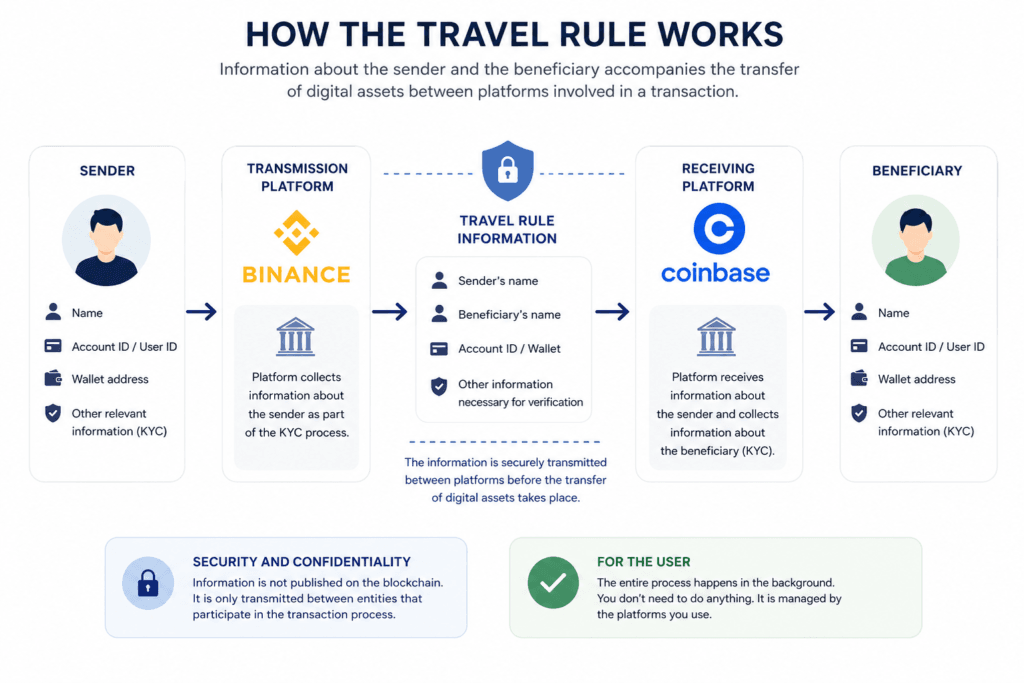
The Travel Rule is a compliance rule that requires certain financial and crypto service providers to transmit information about the sender and recipient of a transaction.
In the cryptocurrency industry, the Travel Rule is one of the main measures used to combat money laundering and terrorism financing.
The application of the Travel Rule in the digital asset sector particularly affects crypto service providers, known in the European Union as CASP (Crypto-Asset Service Provider).
What does Travel Rule mean?
The name can be confusing because the rule is not related to travel.
The term “Travel Rule” comes from the fact that certain information must “travel” with the transfer of funds or digital assets between the institutions involved in the transaction.
When a user sends digital assets through a crypto platform, certain information about the sender and recipient must be collected and transmitted according to applicable requirements.
Concrete example
If you send Bitcoin from Binance to Coinbase, Binance transmits to Coinbase certain necessary information to identify the transaction and the users involved.
If instead you send Bitcoin from Binance to a personal wallet like Ledger, the situation is different because there is no second platform to receive and verify this information.
This entire process takes place in the background and is managed by the platforms you use.
Why was the Travel Rule created?
The Travel Rule was initially introduced in the traditional financial system to combat money laundering and the financing of illegal activities.
As the cryptocurrency market grew, authorities considered that similar rules should also apply to digital asset transfers.
The main goal is to increase transparency and facilitate the identification of suspicious transactions.
The Travel Rule is promoted internationally by the FATF (Financial Action Task Force), the organization that sets global standards for combating money laundering and terrorism financing.
In the European Union, the application of the Travel Rule has been strengthened through new rules on fund and crypto asset transfers and works in parallel with regulations like MiCA. For details on European-level implementation, you can consult the information published by the European Banking Authority (EBA).
What information is transmitted through the Travel Rule?
The exact information can vary depending on the jurisdiction and type of transaction, but generally can include:
- sender’s name
- recipient’s name
- identifiers of the accounts or wallets used
- information necessary for verifying the identity of the parties involved
This information is not published on the blockchain. It is transmitted between the entities participating in processing the transaction.
Who must comply with the Travel Rule?
In the crypto sector, the Travel Rule mainly applies to service providers that facilitate digital asset transfers on behalf of users.
These companies can include centralized exchanges, custody services, and other platforms that fall into the category of CASP.
The implementation of the Travel Rule is closely linked to KYC and AML procedures.
Travel Rule and self-custody wallets
One of the most discussed topics related to the Travel Rule is how it applies to transfers involving self-custody wallets.
A self-custody wallet is a wallet where the user directly controls the private keys and does not rely on an intermediary for access to funds. Popular examples include hardware wallets like Ledger and Trezor.
If you send digital assets from a centralized platform to a personal wallet, the platform may be required to collect certain information before processing the transfer. The exact rules can vary depending on the jurisdiction and service provider used.
Travel Rule vs DAC8
The Travel Rule and DAC8 are often confused because both involve the exchange of information and increasing transparency in the crypto industry. In reality, the two regulations pursue different objectives.
| Travel Rule | DAC8 |
|---|---|
| Combating money laundering | Tax transparency |
| Applies to digital asset transfers | Applies to tax reporting |
| Identifies sender and recipient | Reports information to tax authorities |
| Related to AML and KYC | Related to taxation |
In short, the Travel Rule aims to combat money laundering, while DAC8 aims to increase tax transparency.
What is the difference between Travel Rule and MiCA?
Travel Rule and MiCA are different but complementary regulations.
MiCA sets rules for the authorization and supervision of crypto service providers, while the Travel Rule regulates the information that must be transmitted in certain digital asset transfers.
In practice, many companies that must comply with MiCA also need to implement procedures compatible with the Travel Rule.
How does the Travel Rule affect ordinary users?
For most users, the Travel Rule operates in the background and does not change how they buy, sell, or transfer cryptocurrencies.
In certain situations, platforms may request additional information before processing a transfer, especially when funds are sent to another platform or a personal wallet.
Frequently Asked Questions
What is the Travel Rule?
The Travel Rule is a compliance rule that requires certain financial institutions and crypto service providers to transmit information about the sender and recipient of asset transfers.
Is the Travel Rule the same as DAC8?
No. The Travel Rule is a measure associated with combating money laundering, while DAC8 is a tax directive concerning the exchange of information between tax authorities.
Is the Travel Rule the same as MiCA?
No. MiCA regulates the crypto market and crypto service providers, while the Travel Rule sets requirements for transmitting certain information in asset transfers.
Does the Travel Rule apply to self-custody wallets?
Yes, but the application is more complex. If you send assets to a personal wallet, the platform used may request additional information before processing the transfer.
Do I need to do anything special as a user?
Generally, no. The Travel Rule is managed by the platforms you use. The most visible effect is the possibility of encountering additional checks before certain transfers.
Is the Travel Rule a tax?
No. The Travel Rule does not introduce taxes and does not change the taxation of cryptocurrencies. It is a compliance rule used to combat money laundering and identify suspicious transactions.
Conclusion
The Travel Rule is a compliance rule that requires certain crypto service providers to transmit information about the sender and recipient of digital asset transfers.
Its purpose is to combat money laundering and increase transparency, not to introduce new taxes for users.