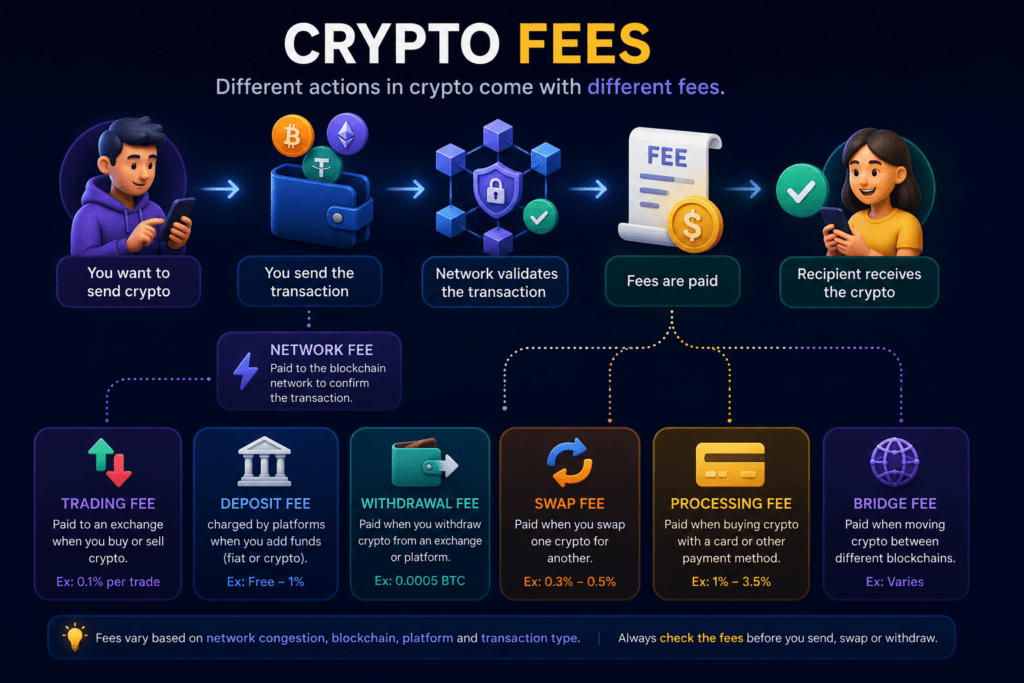
A crypto fee is the cost you pay to execute a transaction on a blockchain or platform. It covers network fees paid to validators, trading fees charged by exchanges, and processing fees charged by ramps. Understanding how they work — and how to reduce them — can save you a significant amount on every transaction.
What are crypto fees?
Crypto fees are the costs associated with sending, buying, selling, or swapping cryptocurrency. Unlike a bank transfer where the fee is a fixed amount set by your bank, crypto fees are dynamic — they change based on the blockchain you use, network congestion, and the platform you transact on.
What Are Crypto Fees?
Every time you move cryptocurrency — whether you’re buying Bitcoin with your card, sending USDT to a friend, or swapping ETH for SOL — at least one fee is involved. Sometimes two or three.
Why do crypto fees exist?
Blockchains don’t have a central authority processing transactions. Instead, a decentralized network of validators (or miners, depending on the blockchain) verifies and records every transaction. Fees are how these validators get paid — they’re the economic incentive that keeps the network secure and running.
Without fees, there would be no incentive for validators to process transactions — and without validators, there would be no blockchain. Fees are not a bug in the system; they are the mechanism that makes it work.
Platforms like exchanges and ramps also charge their own fees on top of the network fee — to cover operational costs, payment processing, and, of course, profit.
Types of crypto fees
Not all fees are the same. Here are the most common types you’ll encounter:
Paid directly to blockchain validators. The most unavoidable fee — exists on every blockchain, just in different amounts. Called “gas” on Ethereum. Varies with network congestion.
Trading fee
Charged by exchanges like Binance or Kraken on every buy/sell order. Typically 0.1–0.25%. Makers (who add liquidity) usually pay less than takers (who remove it).
Withdrawal fee
Charged by exchanges when you move crypto to your own wallet. Often a fixed amount per coin, separate from the network fee — and usually higher than it.
Processing fee
Charged by crypto ramps like Abarai when you buy with a debit/credit card or bank transfer. Covers card network costs and platform operations. Usually the most visible fee — shown upfront.
What determines how much you pay?
The fee you pay is never random. Four main factors determine it:
1. The blockchain you use
Ethereum is expensive. Solana and TRON are cheap. Sending USDT on ERC-20 (Ethereum) costs dramatically more than sending the same amount on TRC-20 (TRON) — same asset, completely different cost.
2. Network congestion
The more people using a blockchain at the same time, the more you pay. During peak activity — a major NFT launch, a market crash — Ethereum fees can spike 10x or more in minutes.
3. The type of transaction
A simple transfer (sending ETH to another wallet) costs less than a smart contract interaction (a DeFi swap). The more complex the operation, the more computational work validators do — and the higher the fee.
4. The platform you use
Every platform sets its own fee structure. Some exchanges charge more for card deposits. Some ramps include the network fee in their quote. Always check the total cost before confirming, not just the headline rate.
How to pay lower crypto fees
You can’t avoid fees entirely — but you can make smarter choices that significantly reduce what you pay.
Choose the right blockchain
This is the single most impactful decision you can make. If you’re sending USDT, you almost always have a choice of network:
ERC-20 (Ethereum)
Network fees: high
Fluctuates heavily with congestion
Best for large amounts where security matters
TRC-20 (TRON)
Network fees: very low
Stable and predictable
Best for everyday USDT transfers
Important: always make sure the recipient’s wallet supports the same network you’re sending on. Sending TRC-20 USDT to an ERC-20 address will result in lost funds.
Don’t always use a crypto exchange
If you want to send cryptocurrency to another person, you don’t always need a crypto exchange. An exchange charges you a trading fee to buy, then a separate withdrawal fee to move it to your wallet — two fees for what could be one step.
A crypto ramp lets you enter the recipient’s wallet address directly. You pay by card, and the crypto goes straight to their wallet — no account needed, no withdrawal step, no extra fees.
Avoid multiple withdrawals
Each withdrawal from an exchange costs a fee. If you’re moving funds out in small batches, you’re multiplying your costs. Consolidate — one larger withdrawal almost always costs less than five small ones.
Check fees before you transact
Every platform shows a fee breakdown before you confirm. Read it. The headline rate (e.g. “0.1% trading fee”) is rarely the full picture — card deposit fees, network fees, and withdrawal fees are often listed separately and can add up quickly.
Practical example — sending 200 USDT
Maria wants to send 200 USDT to her brother. Here’s what happens depending on the route she takes.
📊 Via crypto exchange
Step 1
Creates account + completes KYC
Step 2
Deposits EUR by card → card deposit fee (1.8–3%)
Step 3
Buys USDT → trading fee (0.1–0.25%)
Step 4
Withdraws to brother’s wallet → withdrawal fee + network fee
Total fees
3–4 separate fees. Process takes hours to days.
🔄 Via crypto ramp
Step 1
Enters the amount and her brother’s wallet address
Step 2
Pays by card → one processing fee, shown upfront
Result
200 USDT arrives directly in her brother’s wallet. No account, no withdrawal step, no extra fees.
Duration: ~5 minutes. One fee, shown upfront.
The exchange route isn’t wrong — it’s designed for trading. But if your goal is simply to send crypto to another person, a ramp is often the simpler and cheaper option.
Crypto fees by blockchain
Network fees change constantly, so exact numbers are meaningless here. What matters is understanding the relative cost of each blockchain:
Crypto fees aren’t just a technical detail. They affect everyday decisions. Here are situations where choosing the right approach makes a real difference:
“I want to send money to my son studying abroad.”
Use a crypto ramp to buy USDT on TRC-20, entering his wallet address directly. One fee, arrives in minutes. No exchange account needed on either side.
“I want to pay a freelancer in USDT.”
Ask the freelancer which network they prefer. If they accept TRC-20, your costs are minimal. Buy USDT via a ramp, enter their address, done.
“I want to buy Bitcoin and gift it to someone.”
Buy via a ramp (abarai or moonpay) and enter their wallet address. No exchange account, no withdrawal step. They receive Bitcoin directly — one transaction, one fee.
“I trade daily on an exchange.”
For active traders, exchanges are the right tool. Focus on reducing trading fees through volume discounts or holding the exchange’s native token (e.g. BNB on Binance).
Frequently asked questions
Why is Ethereum so expensive?
Ethereum’s fees (called “gas”) are determined by demand for block space. When many transactions compete to be processed at the same time — during DeFi activity, NFT mints, or market volatility — validators prioritize higher bids. This auction-style mechanism means fees can spike dramatically during peak periods.
What is a network fee?
A network fee (also called a gas fee or transaction fee) is the cost paid directly to blockchain validators to process and confirm your transaction. It exists on every blockchain — the amount depends on which blockchain you use and how busy it is at the time.
Can I send USDT via TRC-20?
Yes. USDT exists on multiple blockchains — including Ethereum (ERC-20), TRON (TRC-20), Solana, and others. TRC-20 is widely used for its very low fees. The key requirement is that both sender and recipient use the same network — sending TRC-20 USDT to an ERC-20 address will result in lost funds.
Who receives the fees?
Network fees go to the validators (or miners) who process transactions on the blockchain. Trading fees, withdrawal fees, and processing fees go to the platform you use — the exchange or ramp. In some cases, a portion of network fees is permanently burned (destroyed), reducing the total supply of the coin.
Can I avoid crypto fees entirely?
No. Every on-chain transaction requires a network fee — this is fundamental to how blockchains work. What you can do is minimize them: choose a low-fee blockchain, avoid congested periods, consolidate withdrawals, and choose platforms with transparent, competitive fee structures.
What’s the difference between a network fee and a withdrawal fee?
A network fee is paid to the blockchain itself. A withdrawal fee is charged by the exchange when you move crypto out of their platform. Many exchanges charge both — their own withdrawal fee on top of the underlying network fee. When comparing platforms, always check the total cost of getting your crypto out, not just the trading fee.