

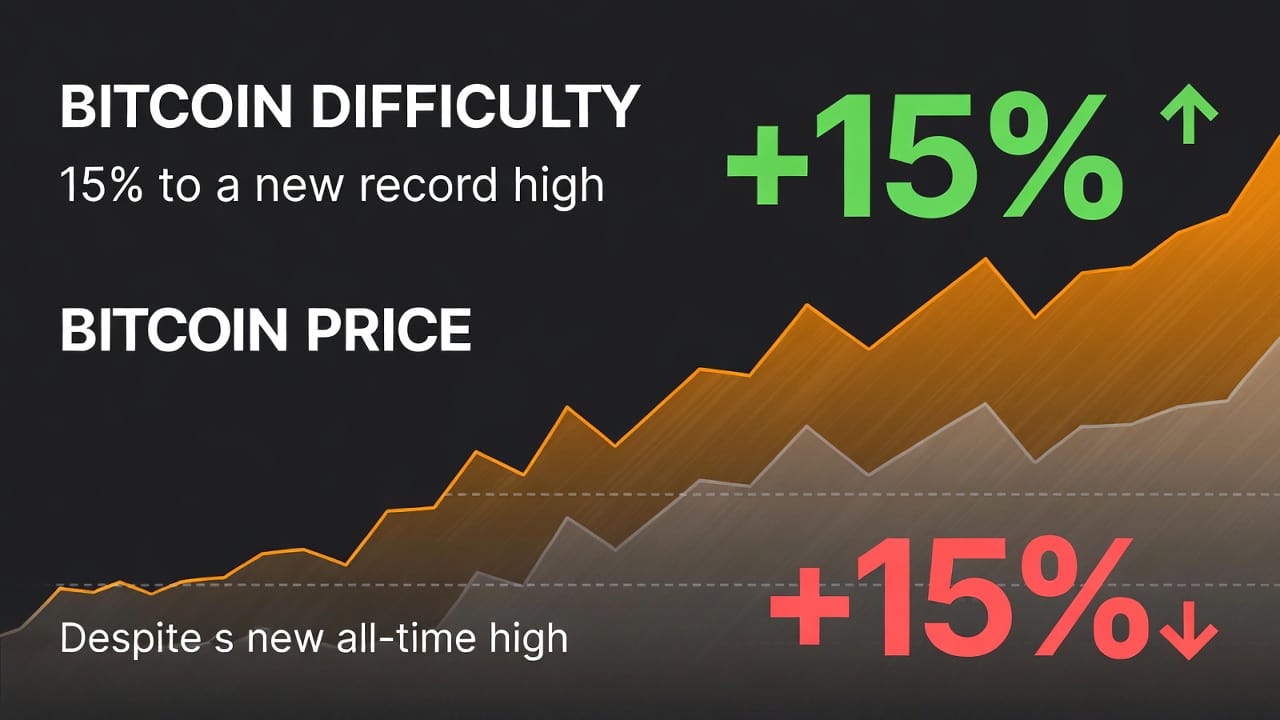
Despite a period marked by fluctuations and declines in Bitcoin’s price, the network continues to strengthen its resilience and security. Recently, Bitcoin mining difficulty recorded a significant increase of 15%, reaching a record level not seen since 2021. This surprising phenomenon raises questions about the internal dynamics of the cryptocurrency ecosystem and the factors influencing both the costs and profitability of mining in the context of a volatile market. In the following, we will explore the causes and implications of this unexpected development.
Impact of Bitcoin Difficulty Increase on Network and Miners
The increase in Bitcoin difficulty has a significant impact on the entire network and especially on miners. In the short term, it generates fiercer competition for block validation, leading to an increased need for computing power and, implicitly, energy consumption. Miners with more efficient equipment and lower energy costs are the ones who can survive and thrive in such an environment, while operators with outdated hardware or high costs may be pushed out of the market. This increases the tendency towards centralization of mining power, which can affect the decentralization of the network, an essential aspect of Bitcoin’s philosophy.
General impact on the network can be summarized as follows:
- Reduction of effective reward rates for miners with less efficient equipment;
- Increased blockchain stability, as the network becomes more resistant to attacks due to increased difficulty;
- Possible temporary stagnation of some small nodes and pools, which may no longer afford the increased costs;
- Incentive for technological innovation, aimed at developing energy-efficient equipment.
| Factor | Effect on Miners | Consequences for Network |
|---|---|---|
| Increase in Difficulty | Requires efficient hardware | More secure blockchain |
| High Energy Costs | Lower profits | Possible reduction in number of nodes |
| Concentration of Miners | Increasing centralization | Risk to decentralization |
Determinant Factors of the 2021 Record in the Current Context
The recent increase in Bitcoin difficulty, reaching a peak in recent years, reflects a complex dynamic that goes beyond the simple price variation of the cryptocurrency. Firstly, it is dictated by an expansion of total mining capacity, where miners invest heavily in more efficient equipment, anticipating the long-term stability of the network. Moreover, improvements in algorithms and network level have fueled this growth, strengthening the security and difficulty of operating the blockchain against cyberattacks.
The factors that determined the 2021 record remain relevant now, their influence manifesting through:
- Increased interest from financial institutions, which continue to adopt Bitcoin as a reserve asset;
- Adaptive regional regulations, which have allowed miners to optimize their operational costs;
- Stability of energy infrastructure in various key countries, facilitating operations for large miners.
| Factor | Impact on Difficulty | Context 2021 vs. 2024 |
|---|---|---|
| Mining Capacity | Increased | Continuously growing |
| Regulations | Adaptive | More favorable in strategic areas |
| Bitcoin Price | Volatile | Temporary decline |
Analysis of Bitcoin Price Evolution in Relation to Mining Difficulty
In recent months, we have observed an interesting relationship between Bitcoin’s price and the network’s mining difficulty. Even though the cryptocurrency’s price has shown a downward trend, mining difficulty has continued to rise, reaching a record level of 15% compared to the last adjustment, a threshold not reached since 2021. This significant increase indicates that miners continue to bring their computing power to the network, betting on potential market recoveries or the long-term stability of Bitcoin. Determinant factors for this dynamic include technological improvements in mining equipment and increased confidence in the fundamental value of the cryptocurrency.
- Adaptability of miners: constant investments in more efficient equipment.
- Energy efficiency: optimizing operational costs to make mining sustainable.
- Long-term strategies: miners maintain optimistic perspectives, even during price declines.
A further look at historical data provides a clear picture of the fluctuating correlation between the two elements:
| Period | Average Bitcoin Price | Mining Difficulty Increase |
|---|---|---|
| Q1 2021 | 45,000 USD | +12% |
| Q3 2021 | 40,000 USD | +18% |
| Q2 2023 | 28,000 USD | +15% |
Thus, it is highlighted that mining difficulty is not always directly proportional to price fluctuations but also reflects long-term technical and market factors that can offer valuable insights to investors and Bitcoin enthusiasts.
Recommended Strategies for Bitcoin Miners in High Difficulty Conditions
Diversifying the mining strategy is another important recommendation during this period. Miners can consider changing mining pools or transitioning to alternative cryptocurrencies with lower difficulties, while maintaining a mixed portfolio to minimize risks. Here are some effective tactics:
- Constantly monitoring hash rate and adjusting the pool based on performance
- Allocating part of the resources to mining altcoins with growth potential
- Updating equipment firmware to maximize efficiency
- Setting clear temporary stop thresholds in case of unjustified energy costs
| Strategy | Benefits | Level of Implementation |
|---|---|---|
| Optimizing energy consumption | Reduced costs, sustainability | High |
| Diversifying pools | Flexibility, risk reduction | Medium |
| Market monitoring and adjustment | Rapid adaptability | High |
Perspectives and Forecasts for the Bitcoin Market in the Coming Months
Even though Bitcoin’s price has recently declined, the increase in mining difficulty indicates sustained confidence in its long-term potential. Miners continue to expand their operational capacity, signaling a resilient network and a promise of stability, regardless of spot market fluctuations. This trend may suggest a period of consolidation, where strategic investors await price correction to reposition their portfolios.
- Technological adoption remains a key factor in supporting the Bitcoin ecosystem.
- Institutional involvement continues to grow, increasing liquidity and market influence.
- Market feedback shows increased interest in scalable solutions and cost-efficient mining.
| Aspect | Forecast |
|---|---|
| Mining Difficulty | Slow growth, medium-term stabilization |
| Price Volatility | Moderate fluctuations, with potential recovery |
| Investor Interest | Gradual increase in institutional segments |
Final Thoughts
In conclusion, even though Bitcoin’s price has recently declined, the network’s difficulty continues to rise, reaching a record level since 2021. This trend reflects the perseverance of miners and their confidence in the future of the cryptocurrency, demonstrating that the ecosystem remains active and resilient in the face of market volatility. Thus, Bitcoin reaffirms its status not only as a digital asset but also as a dynamic technological force, ready to adapt to challenges and write new chapters in its fascinating evolution.