Why is cryptography important for cryptocurrencies?
Quick Answer
Cryptography is the mathematical foundation on which every cryptocurrency is built. Without it, there would be no blockchain, no secure transactions, and no verifiable digital ownership. It is the reason why nobody can counterfeit a Bitcoin or steal funds from a wallet without the private key.
Cryptography is the science of securing information by transforming it into a form that can only be read by an authorised recipient. The word comes from Greek: kryptós (hidden) and gráphein (to write).
Before the digital age, cryptography was used by armies and intelligence services to transmit secret messages. Today it is present in every aspect of digital life — from the HTTPS in your browser, to online payments, to messaging apps and, of course, to cryptocurrencies.
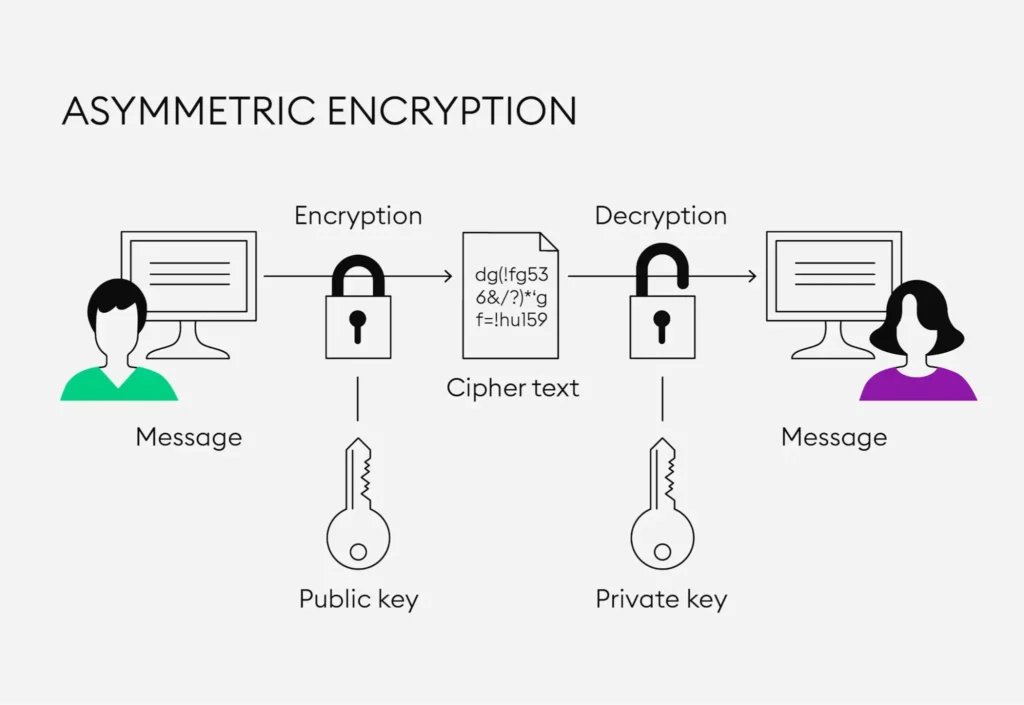
Simple analogy: Cryptography is like an invisible lock on every message or transaction. The public key is the address where you can receive — you give it to anyone. The private key is the lock combination — you never give it to anyone.
A brief history of cryptography — from Caesar to Satoshi
Cryptography did not appear with Bitcoin. It has a history spanning over 2,000 years.
~50 BC — Caesar’s cipher
Julius Caesar used a simple substitution system — each letter in a message was replaced by the letter three positions further along in the alphabet. “A” became “D”, “B” became “E”. The first documented cryptographic system in history.
1940–1945 — Enigma and the Second World War
Nazi Germany used the Enigma machine to encrypt military communications. The code was broken by Alan Turing and his team at Bletchley Park — shortening the war by years and laying the foundations of modern computing. Turing is considered the father of the modern computer — and indirectly, of digital cryptography.
1976 — The public key cryptography revolution
Whitfield Diffie and Martin Hellman publish “New Directions in Cryptography” — the paper that changes everything. Until then, the sender and receiver of an encrypted message had to exchange a secret key in advance (the problem: how do you do this without being intercepted?). Diffie-Hellman solves this through pure mathematics — the public key can be freely distributed; only the private key must be kept secret.
1977 — RSA
Rivest, Shamir and Adleman develop the RSA algorithm — the first practical asymmetric cryptography system. Based on the difficulty of factorising large prime numbers, RSA underpins internet security to this day and is one of the mathematical concepts that makes private and public keys in crypto possible.
1997 — Hashcash and Proof of Work
Adam Back invents Hashcash — a proof-of-work system based on hash functions, originally designed to combat email spam. The concept would later be adopted by Satoshi Nakamoto as the consensus mechanism for Bitcoin.
2008 — Satoshi Nakamoto combines it all
The Bitcoin whitepaper does not invent any new cryptographic technology. Satoshi’s genius was combining public key cryptography, hash functions and proof of work into a system that solves the double-spend problem without a central authority. The blockchain is born.
Types of cryptography used in crypto
The crypto ecosystem uses several types of cryptography, each with a specific role:
🔑 Asymmetric cryptography (public/private key)
What it does: Allows anyone to send you funds (using your public key), but only you to access them (with your private key).Asymmetric cryptography
How it works: Based on mathematically linked key pairs — what is encrypted with one can only be decrypted with the other. It is impossible to deduce the private key from the public key, even if you have both. Main algorithm in crypto: ECDSA (Elliptic Curve Digital Signature Algorithm) — used by Bitcoin and Ethereum to sign transactions.
#️⃣ Cryptographic hash functions
What it does: Transforms any amount of data into a fixed-length string of characters (a digital fingerprint). The same input always produces the same hash. Any minimal change in the data produces a completely different hash. Critical properties: Irreversible (you cannot reconstruct the data from the hash), deterministic, and collision-resistant (practically impossible to find two data sets with the same hash). Main algorithm:SHA-256 (used by Bitcoin for mining and block validation), Keccak-256 (used by Ethereum).
✍️ Digital signatures
What it does: Proves that a transaction was authorised by the legitimate owner of the funds, without revealing the private key. How it works: When you send crypto, your wallet signs the transaction with your private key. The network verifies the signature using your public key — confirming it was you, without knowing your secret. Analogy: Like a notarised signature — it proves authenticity without fully revealing identity.
🌳 Merkle trees
What it does: Enables efficient verification of a large number of transactions without downloading the entire blockchain. How it works: Transactions in a block are hashed in pairs, recursively, down to a single root hash (the Merkle Root). If any transaction is modified, the Merkle Root changes — immediately detecting fraud. Practical importance: Underpins Simplified Payment Verification (SPV) — allowing mobile wallets to verify transactions without downloading the entire blockchain.
How cryptography protects a crypto transaction — step by step
When you send Bitcoin, Ethereum or any other cryptocurrency, several layers of cryptography act simultaneously:
1. Your wallet builds the transaction
It specifies: the recipient’s address, the amount, and the fee. All of this is combined into a structured message that is about to be signed.
2. The transaction is hashed
The transaction message passes through SHA-256 (or the network’s equivalent algorithm) and produces a unique hash. Any subsequent modification to the transaction would produce a completely different hash — immediately detecting any tampering attempt.
3. The hash is signed with your private key
The ECDSA algorithm combines the hash with your private key and produces a unique digital signature. This signature proves that you authorised the transaction, without exposing your private key.
4. The signed transaction is broadcast to the network
Every node in the network verifies the signature using your public key. If the signature is valid and the funds exist, the transaction is accepted into the mempool.
5. The transaction is included in a block and hashed into the chain
Miners or validators add the transaction to a block. Each block contains the hash of the previous block — creating the cryptographic chain. Modifying any block would invalidate all subsequent blocks, making falsification of the history practically impossible.
Why cryptography is essential for cryptocurrencies
Cryptography solves five fundamental problems that made decentralised digital money impossible before Bitcoin:
🚫
Preventing double spending
Without cryptography, the same Bitcoin could be sent to two different addresses simultaneously. Hashes and digital signatures make this impossible — every transaction is unique and verifiable.
🔐
Ownership without a bank
Public key cryptography enables verifiable digital ownership without a central authority. If you hold the private key, you hold the funds — no bank account, no permission required.
🛡️
Immutability of history
Cryptographically linked hashes make it impossible to modify historical transactions without rewriting the entire chain — across all nodes simultaneously.
✅
Trustless verification
Anyone can verify any transaction in the blockchain’s history without needing to trust any entity. Mathematics replaces trust.
⚡
Decentralised consensus
Proof of Work and Proof of Stake use cryptography to allow thousands of participants to reach the same truth without a central authority.
🕵️
Pseudonymity
Crypto addresses are cryptographically derived from public keys — they contain no name or personal data. Transactions are public, but identity remains pseudonymous.
The private key and the public key — the heart of crypto cryptography
If you understand just one concept from crypto cryptography, it must be the private/public key pair. Everything starts here.
🔓 Public key
Mathematically derived from the private key. Can be freely distributed — it is the equivalent of an IBAN. Anyone can use it to send you funds or to verify your signatures. Does not compromise security.
🔒 Private key
A random 256-bit number. The only way to access and send funds. If you lose it, you lose access to your funds forever. If you expose it, anyone can take your funds. Never share it with anyone.
🧮 How an address is derived from a key — simplified
The process is irreversible — you cannot reconstruct the private key from the address, nor from the public key.
Seed phrase — cryptography made accessible
A private key is an enormous number, difficult to memorise or write down. That is why modern wallets use a standard called BIP-39, which converts the private key into 12 or 24 common dictionary words — the seed phrase (recovery phrase).
Example seed phrase (fictional — never use one found online): abandon ability able about above absent absorb abstract absurd abuse access accident
These 12 words can completely regenerate the private key and all associated addresses. Whoever holds them holds the funds. Write them on paper, store them physically in a safe place, and never enter them online.
Cryptography in different cryptocurrencies
Each blockchain network uses cryptography differently, depending on its priorities — security, speed or privacy:
Network
Signature algorithm
Hash function
Specifics
Bitcoin
ECDSA (secp256k1)
SHA-256
Taproot adds Schnorr signatures — more efficient and more private
Ethereum
ECDSA (secp256k1)
Keccak-256
Same signature algorithm as BTC, different hash function
Similar architecture to Ethereum, optimised for speed
Solana
EdDSA (Ed25519)
SHA-256
Ed25519 is faster and more resistant to certain attacks
Monero
EdDSA (Ed25519)
Keccak-256
Ring signatures for complete transaction privacy
The quantum threat — the future of crypto cryptography
Quantum computers represent a theoretical threat to current cryptography. Shor’s algorithm, run on a sufficiently powerful quantum computer, could break ECDSA — the signature algorithm used by Bitcoin and Ethereum.
How imminent is the threat? Current quantum computers are far below the threshold needed to attack current cryptography. Expert estimates range from 10 to 30 years before this threat becomes real.
The industry’s response: NIST (the US National Institute of Standards and Technology) finalised the first post-quantum cryptography standards in 2024. Ethereum and other networks have the transition to quantum-resistant algorithms on their roadmap. Bitcoin, by its conservative nature, will follow more slowly — but the community is closely monitoring developments.
Frequently asked questions about cryptography and cryptocurrencies
Why is cryptography important for cryptocurrencies?
Cryptography solves the fundamental problem of decentralised digital money: how do you prove you own funds without a bank or central authority to confirm it? Without cryptography there is no blockchain, no verifiable digital ownership, and no protection against double spending.
What is a private key and why is it so important?
A private key is a random 256-bit number that gives you exclusive access to your crypto funds. Whoever holds the private key holds the funds — without exception. If you lose it, there is no recovery. If you expose it, funds can be stolen instantly.
Can Bitcoin’s cryptography be broken?
With current classical computers, no. Brute-forcing a 256-bit private key would require more energy than exists in the universe and more time than the age of the universe. Quantum computers represent a theoretical future threat, but the industry is already working on solutions.
What is SHA-256?
SHA-256 (Secure Hash Algorithm 256-bit) is the cryptographic hash function used by Bitcoin for mining and block validation. It transforms any data into a 256-bit string. It is irreversible, deterministic, and any minimal change in the data produces a completely different hash.
What is the difference between symmetric and asymmetric cryptography?
Symmetric cryptography uses the same key for both encryption and decryption (the problem: how do you transmit the key safely?). Asymmetric cryptography uses two mathematically linked keys — one public (freely shared) and one private (secret). Cryptocurrencies use asymmetric cryptography to enable digital ownership without intermediaries.
What does a crypto wallet do from a cryptographic standpoint?
A wallet does not “store” crypto — crypto exists on the blockchain. A wallet stores private keys and manages digital signatures. When you send a transaction, the wallet signs it with your private key, proving you are the owner of the funds.