

What is TRON (TRX)?
TRON is a blockchain network created for fast transfers of cryptocurrencies and decentralized digital applications. The project became particularly known for its very low fees and high transaction speed.
The cryptocurrency used in the network is called TRX and is used for transfers, paying fees, and interacting with applications built on the Tron blockchain.
In recent years, the TRON network has become one of the most used infrastructures for transferring USDT on the TRC20 standard, as it allows funds to be moved quickly and at lower costs compared to other popular blockchains.
Many users use the Tron network for:
- quick transfers between wallets
- moving USDT between exchanges
- storing cryptocurrencies
- Web3 applications and blockchain services
- transactions with low fees
Unlike older blockchains like Bitcoin, the Tron network was built for a large number of transactions and for the lowest possible usage costs.
Today, TRON is one of the most used blockchain networks in the crypto ecosystem, especially for international transfers and the use of stablecoins like USDT.
How the TRON network works
The TRON network functions as a decentralized blockchain, meaning that transactions are validated and recorded by multiple nodes distributed worldwide, not by a single company or institution.
The main purpose of the network is to enable fast transfers of digital assets and run blockchain applications at the lowest possible costs for users.
TRON blockchain explained simply
The TRON blockchain is essentially a distributed digital database where each transaction is recorded and verified by the network.
When someone sends TRX or USDT through the Tron network:
- the transaction is broadcast to the network
- validators verify the transaction data
- the information is added to a new block
- the transaction becomes visible and confirmed on the blockchain
This system allows the transfer of cryptocurrencies without intermediaries like banks or traditional payment processors.
How transactions are processed on the TRON network
TRON uses a system called Delegated Proof of Stake (DPoS), different from the mechanisms used by blockchains like Bitcoin.
Instead of thousands of computers consuming large amounts of energy for validation, the Tron network uses a smaller number of validators who process transactions quickly and efficiently.
This model helps the network handle a large volume of transfers without high fees and long confirmation delays.
Why transfers on TRON are so fast
One of the main reasons the Tron network has become so popular is the speed of transactions.
In most cases:
- transfers are confirmed in a few seconds
- fees are very low
- the network can process many transactions simultaneously
For this reason, TRON is frequently used for USDT transfers between exchanges and wallets, especially by users who want low costs and fast confirmations.
What is the TRX token and what is it used for
TRX is the native cryptocurrency of the TRON network and has several important roles in the functioning of the ecosystem. Essentially, the token is used for transfers, paying network resources, and interacting with applications built on the Tron blockchain.
Just as ETH is used in the Ethereum network or BTC in the Bitcoin network, TRX is the main asset that supports the Tron infrastructure.
Payment of network fees
When users send cryptocurrencies or use certain applications in the Tron ecosystem, the network consumes resources to process transactions.
In many situations, these costs are paid using TRX. However, one of the advantages of the Tron network is that the fees are usually very low compared to other popular blockchains.
This is one of the reasons why many users choose TRON for fast transfers of USDT and other digital assets.
Staking and network validation
TRX can also be used for staking, which means temporarily locking coins to support the network’s operation.
Through staking, users can:
- indirectly participate in securing the blockchain
- receive rewards in TRX
- obtain resources like Energy and Bandwidth
- vote for Tron network validators
This system is part of the Delegated Proof of Stake mechanism used by the Tron blockchain.
Transfers and use in the Tron ecosystem
In addition to classic transfers, TRX is also used in many applications developed on the Tron network.
The token can be used for:
- transfers between wallets
- payments and digital transactions
- staking and rewards
- DeFi applications
- blockchain games and Web3 applications
Due to its high speed and low fees, TRX has become one of the most used cryptocurrencies for quickly moving funds between crypto platforms and wallets.
What is the TRC20 network
TRC20 is the standard used for tokens created and transferred on the Tron blockchain. If you have ever sent USDT through the Tron network, you most likely used the TRC20 standard.
In the crypto ecosystem, standards like TRC20 or ERC20 define the rules by which tokens operate on a blockchain.
In the case of the Tron network, TRC20 allows:
- fast token transfers
- compatibility between wallets and exchanges
- use of applications built on the Tron blockchain
- low transaction costs
Today, TRC20 is one of the most used standards for stablecoin transfers, especially for USDT.
Difference between TRC20 and ERC20
TRC20 and ERC20 are similar in functionality, but they operate on different blockchains.
- TRC20 belongs to the Tron network
- ERC20 belongs to the Ethereum network
The biggest difference between them is related to transaction costs and speed.
In general:
- TRC20 transfers are faster
- fees are lower
- Ethereum has a larger ecosystem and more applications
For this reason, many users choose TRC20 when they want to quickly transfer USDT between exchanges or wallets without high costs.
Why is TRC20 so popular for USDT
The Tron network has become extremely popular for USDT transfers because it offers one of the cheapest and fastest methods of moving funds.
For many users, the cost difference compared to other networks can be significant, especially when making frequent transfers.
Today, millions of USDT transactions are processed daily through the TRC20 network, and many exchanges and wallets offer full support for this standard.
Who created TRON?
TRON was created by Chinese entrepreneur Justin Sun, one of the most well-known and controversial figures in the crypto industry. The project was officially launched in 2017, at a time when blockchains were becoming increasingly popular due to the rapid growth of the cryptocurrency market.
The initial goal of the project was to build a fast and accessible blockchain infrastructure capable of supporting decentralized applications and large-scale digital transfers.
Justin Sun and the launch of the project
Before TRON, Justin Sun became known in the Asian tech industry due to his involvement in blockchain projects and technology companies.
After the launch, TRON quickly attracted the attention of the crypto community due to:
- the high speed of the network
- very low fees
- focus on fast transfers
- development of the Web3 ecosystem
Over time, the project grew significantly and began to be used by millions of users for digital asset transfers and stablecoins like USDT.
Evolution of the Tron ecosystem
Over the years, the Tron ecosystem has expanded far beyond the simple TRX cryptocurrency. Today, the network includes:
- decentralized applications (dApps)
- DeFi services
- staking and validators
- NFTs
- international stablecoin transfers
The popularity of the network has increased especially due to massive use for USDT transfers through the TRC20 standard, one of the cheapest methods of moving funds between wallets and exchanges.
For users who want to better understand how to buy and use TRON in practice, there are also dedicated guides on the simplest methods to buy TRX.
Why is TRON so popular
TRON has become one of the most used blockchain networks due to the combination of high transaction speed and low usage costs. For many users, these two things are more important than complex functions or highly technical ecosystems.
Especially in the case of international transfers and stablecoins like USDT, the Tron network is used daily by millions of people worldwide.
Low fees and fast transfers
One of the main advantages of the Tron network is that transactions are processed quickly and have very low costs compared to other popular blockchains.
In practice, this means that users can:
- send funds in seconds
- avoid high fees
- transfer small amounts without high costs
- quickly move crypto between platforms and wallets
This is one of the reasons why TRON is preferred by many users who make frequent transfers.
Use for USDT transfers
The Tron network has become extremely popular due to USDT transfers through the TRC20 standard.
Today, many exchanges and wallets use TRC20 because:
- transactions are fast
- costs are low
- the infrastructure is well integrated
- transfers work efficiently between platforms
For many users, TRON has practically become the main standard for quickly moving stablecoins.
Network popularity in exchanges and wallets
Currently, most major crypto platforms offer full support for TRON and TRC20.
The network is compatible with:
- centralized exchanges
- mobile wallets
- hardware wallets
- DeFi applications
- Web3 services
Due to this extensive compatibility, users can buy TRON (TRX), transfer, and store the cryptocurrency quite easily, regardless of the platform they use.
Advantages and disadvantages of the TRON network
Like any major blockchain, TRON has both advantages and limitations. For some users, speed and low costs are enough to choose this network, while others prefer more developed ecosystems like Ethereum.
In practice, the choice depends on how each person uses cryptocurrencies.
Advantages of the TRON network
The biggest advantage of the Tron network is the efficiency of transfers. Transactions are fast, and costs are generally very low compared to many other popular blockchains.
Among the most important advantages are:
- fast transfers
- low fees
- high popularity for USDT
- wide support in exchanges and wallets
- simple experience for new users
For many users, TRON is one of the most practical networks for stablecoin transfers and quickly moving funds between platforms.
Disadvantages of the TRON network
At the same time, TRON is sometimes criticized for its higher level of centralization compared to other blockchains.
Also, the ecosystem of applications developed on Tron is smaller than that built around Ethereum or other major networks.
Among the frequently mentioned disadvantages are:
- dependence on a smaller number of validators
- smaller DeFi ecosystem than Ethereum
- strong association with stablecoin transfers
- controversies related to Justin Sun and project leadership
Even so, TRON continues to remain one of the most used blockchain networks for fast transfers and low costs.
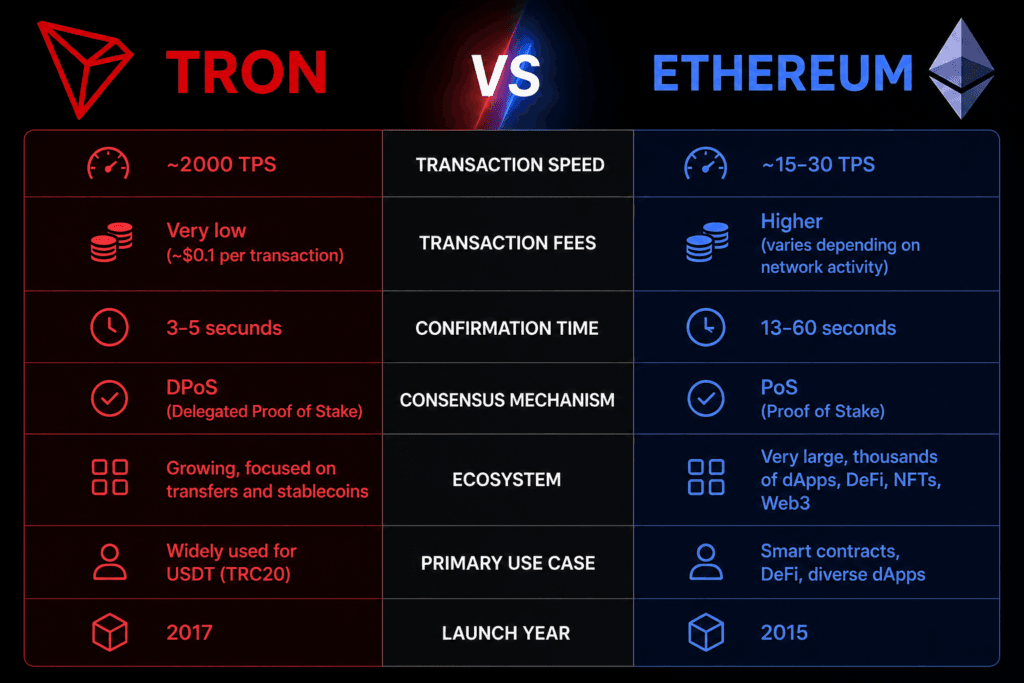
TRON vs Ethereum
TRON and Ethereum are two of the most well-known blockchain networks in the crypto industry, but they were built with different priorities.
Ethereum is considered one of the most developed ecosystems for decentralized applications and smart contracts, while TRON has focused more on fast transfers and low costs.
Differences in speed and costs
One of the biggest differences between the two networks is related to fees and transaction confirmation time.
In general:
- TRON offers faster transfers
- fees on TRON are lower
- Ethereum can have high fees during busy periods
- transfers on Ethereum can take longer depending on traffic
For this reason, many users choose TRON when transferring USDT or other digital assets between exchanges and wallets.
Differences in ecosystem and adoption
Ethereum has one of the largest blockchain ecosystems in the world and supports thousands of DeFi applications, NFTs, and Web3 projects.
TRON, on the other hand, is mainly used for:
- fast cryptocurrency transfers
- transactions with stablecoins
- applications with low costs
- moving funds between platforms
Although Ethereum is considered more technically developed and ecosystem-rich, TRON has become extremely popular due to its simplicity and low usage costs.
How you can buy TRON (TRX)
There are several methods by which users can buy TRON, and the choice depends on each person’s experience and how they want to use the cryptocurrencies later.
Some users prefer traditional exchanges for trading functions and access to more digital assets, while others look for simpler solutions where they can receive cryptocurrencies directly in their own wallet.
Currently, the most popular methods for buying TRX are:
- crypto exchanges like Binance or Kraken
- fintech applications
- services that send crypto directly to the user’s wallet
For users who want the simplest process, there are also options to buy TRX directly in the wallet without needing additional withdrawal steps from an exchange.
If you want to see more options and the differences between them, you can also consult the guide on the simplest methods to buy TRX.
Regardless of the chosen platform, it is important to always check:
- the network used for transfer
- wallet compatibility
- total fees
- estimated time for transaction processing
For most new users, the simplicity of the process and control over funds are the most important things when choosing a method to buy TRON.
Where you can store TRX
After buying cryptocurrencies, the next important step is choosing a safe place to store them. In the case of TRON, users have several types of wallets and platforms compatible with the Tron network.
The choice mainly depends on how often you use cryptocurrencies and how much control you want over your funds.
Wallets compatible with the Tron network
TRX can be stored in various types of crypto wallets, including mobile applications, browser extensions, or hardware wallets.
Among the most popular options are:
- Trust Wallet
- TronLink
- Ledger
- SafePal
- crypto exchanges compatible with TRC20
Most of these wallets also allow storing USDT on the Tron network, not just the TRX token.
Storage on exchange vs own wallet
Many users choose to keep cryptocurrencies directly on the exchange after purchase, especially if they use the platform for active trading.
However, users who want full control over their funds usually prefer their own wallets, where only they have access to the private keys.
An own wallet offers more independence and control, but also comes with the responsibility of protecting the seed phrase and access data.
In general:
- exchanges are simpler for beginners
- own wallets offer more control and security
- hardware wallets are preferred for long-term storage
For users who frequently use the Tron network, compatibility with the TRC20 standard is one of the most important things to check before choosing a wallet.
TRX price evolution
Like most major cryptocurrencies, the price of TRX has gone through periods of rapid growth, but also through strong corrections. Since the project’s launch in 2017, TRON has become one of the most watched cryptocurrencies in the market, especially due to the network’s popularity for USDT transfers.
In periods when the crypto market has grown strongly, TRX has attracted much interest from investors and users looking for projects with real utility and low fees.
Among the factors that frequently influence the price of TRX are:
- adoption of the Tron network
- use of USDT on TRC20
- evolution of the crypto market in general
- listings on major exchanges
- investor interest in blockchain projects
Over time, TRX has experienced several periods of high volatility, and its price has been influenced by both the general market sentiment and the evolution of the Tron ecosystem.
If you want to see in more detail how the price has evolved over time, you can also consult the analysis on TRON (TRX) all-time high.
Is TRON (TRX) a good investment?
TRON is considered by many users to be one of the most useful blockchains for fast and cheap cryptocurrency transfers. The network’s popularity for USDT and low costs have helped the Tron ecosystem remain relevant even in more difficult periods for the crypto market.
However, like any other digital asset, TRX remains a volatile cryptocurrency, and its price can fluctuate strongly in a short time.
For some investors, the main strengths of the project are:
- real use of the network
- popularity of the TRC20 standard
- fast and cheap transfers
- large adoption for stablecoins
At the same time, there are also risks that need to be considered:
- volatility of the crypto market
- competition with other blockchains
- regulatory changes
- ecosystem dependence on USDT usage
As with any cryptocurrency, it is important for users to be well-informed before investing and to understand both the advantages and risks associated with the crypto market.
For many users, TRON is seen more as a practical infrastructure for fast transfers than as a simple speculative asset.
Frequently asked questions about TRON (TRX)
What does TRX mean?
TRX is the native cryptocurrency of the TRON network and is used for transfers, staking, and paying for resources needed for transactions in the ecosystem.
What is the TRC20 network?
TRC20 is the standard used for tokens created on the Tron blockchain. It is frequently used for USDT transfers due to its high speed and low fees.
What is TRON used for?
The TRON network is used for fast cryptocurrency transfers, blockchain applications, staking, and transfers of stablecoins like USDT.
Is TRON different from Bitcoin?
Yes. Bitcoin was created mainly as a decentralized digital currency, while TRON is a blockchain network built for fast transfers and decentralized applications.
Can you transfer USDT through the Tron network?
Yes. The Tron network is one of the most popular options for USDT transfers due to low costs and high transaction speed.