

USDT (Tether) is a stablecoin, meaning a cryptocurrency designed to maintain a stable value. Normally, 1 USDT tracks the value of one US dollar (USD), which is why it is one of the most used cryptocurrencies in the world for trading, transfers, and storing value.
If you’ve seen the terms USDT, Tether, or USDt and wondered what they mean, this guide explains in simple terms how this cryptocurrency works, its advantages and risks, and how it can be used in the crypto ecosystem.

What is the USDT cryptocurrency?
USDT, also known as Tether, is a stable cryptocurrency (stablecoin) designed to maintain a value as close as possible to that of the US dollar. In other words, the main purpose of USDT is to offer the advantages of blockchain technology without the volatility associated with many other cryptocurrencies. Launched in 2014 by Tether Limited, USDT has become one of the most used cryptocurrencies in the world. Due to its stability, it is used daily by millions of users for trading, international transfers, and value storage in the crypto ecosystem. Unlike Bitcoin or Ethereum, whose price can fluctuate significantly in a short period, the value of USDT is designed to remain as close as possible to 1 USD. This makes it a useful tool for investors who want to reduce exposure to market volatility without completely leaving the cryptocurrency ecosystem. Currently, USDT is available on multiple blockchain networks and is accepted by most crypto trading platforms, being one of the most liquid and used cryptocurrencies globally.
How does USDT work?
USDT maintains its value close to 1 US dollar through a mechanism known as a “peg”. The peg represents the mechanism by which the value of a currency is kept close to the value of another asset. The purpose of this mechanism is for each unit of USDT in circulation to be backed by reserves held by the issuer Tether.
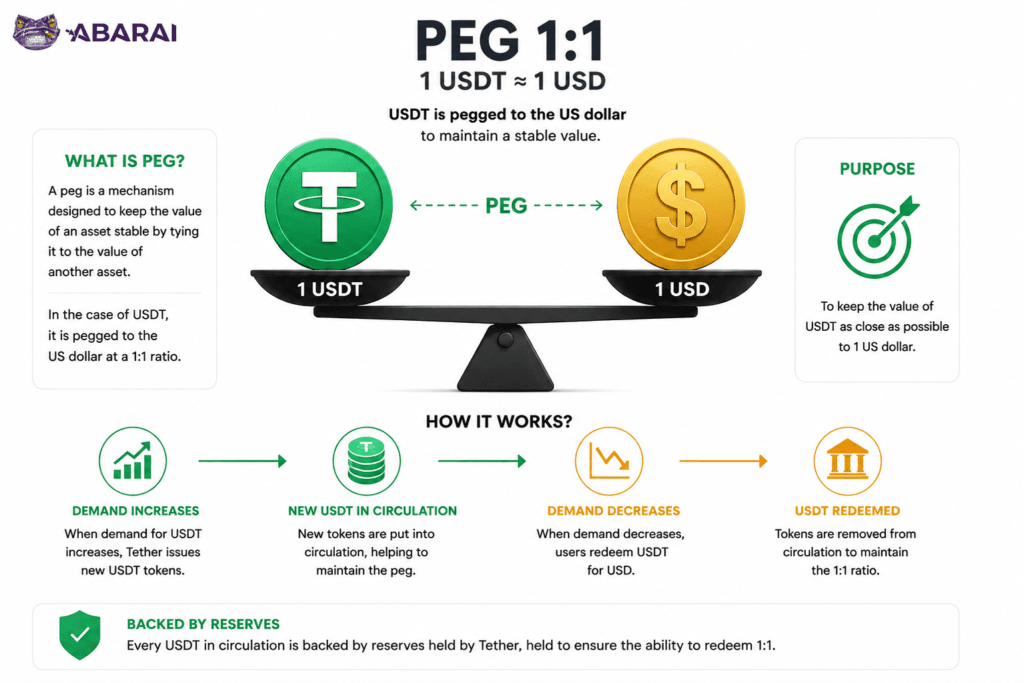
When demand for USDT increases, new tokens can be issued and put into circulation. Conversely, when users redeem USDT, they can be withdrawn from circulation. This process helps maintain a value as close as possible to 1 USD. In practice, the price of USDT can fluctuate slightly above or below the value of 1 dollar, but these variations are usually small and temporary. It is precisely this stability that differentiates it from cryptocurrencies like Bitcoin, Ethereum, or Solana, whose prices can register significant variations in a short period. Because it operates on blockchain, USDT can be quickly transferred between users and crypto platforms worldwide, without relying on bank schedules or traditional payment systems.
Why is USDT so popular?
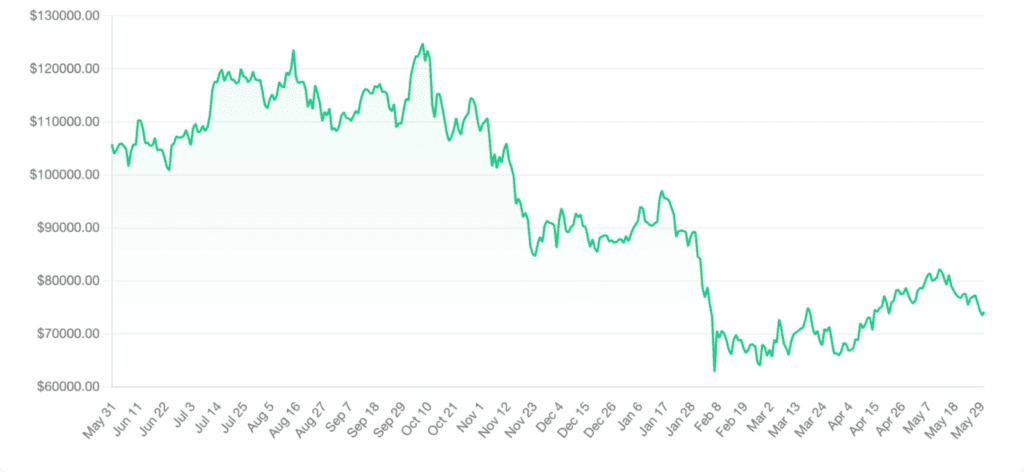
USDT is not only one of the most well-known cryptocurrencies in the world but also one of the most used in the daily activities of users and companies in the crypto ecosystem. Its popularity is due to the fact that it offers a rare balance between the stability of the US dollar (fiat money) and the advantages of blockchain technology. One of the main reasons people use USDT is protection against volatility. While assets like Bitcoin or Ethereum can experience significant price fluctuations in a short period, USDT is designed to maintain a value close to 1 US dollar. This allows investors to keep their funds in the crypto ecosystem without being constantly exposed to market price changes.
USDT also plays an important role in countries where access to banking services is limited or where the local currency faces inflation issues. For many users, the stablecoin issued by Tether represents a simple way to hold a digital version of the US dollar. Thus, savings can be protected from the depreciation of local currencies, and value transfers can be made quickly through blockchain. International transfers are another reason why USDT has seen accelerated adoption.
Unlike traditional banking systems, which can involve delays and high fees, transactions with USDT can be completed in a few minutes, regardless of the country in which the sender or recipient is located. This is useful for both individuals and companies making payments to international partners. An essential factor in USDT’s success is its very high liquidity. The stablecoin is listed on almost all major trading platforms and is used as a main pair for buying and selling other cryptocurrencies. Due to large trading volumes, users can enter and exit positions quickly, without significant differences between buying and selling prices. In addition to its use in trading, USDT is used for commercial payments, settling invoices between companies, remitting money to family, and short-term value storage. In many situations, it acts as a bridge between the traditional financial system and the blockchain ecosystem, providing quick access to digital dollars without the need for banking intermediaries (peer to peer).
All these features have contributed to transforming USDT into one of the most important digital assets in the world. Today, millions of users use it daily for transfers, savings, trading, and payments, which explains why Tether continues to be one of the most popular cryptocurrencies on the market.
On which blockchains does USDT operate?
An important aspect you need to know is that USDT does not operate on a single blockchain network. Over time, Tether has been issued on multiple blockchains to offer users faster transfers, lower costs, and compatibility with different crypto platforms and applications. Although the value of USDT remains the same regardless of the network used, the user experience may differ depending on transaction fees, transfer speed, and the chosen blockchain ecosystem. Among the most popular networks that support USDT are Tron, Ethereum, and BNB Chain.
USDT on Tron (TRC20)
USDT TRC20 is one of the most popular versions of Tether and operates on the Tron blockchain. This variant was launched in 2019, after Tether announced a partnership with the Tron ecosystem to offer users faster and more accessible transfers.
Currently, the Tron network is preferred by millions of users who transfer USDT between wallets, exchanges, and crypto platforms. Its popularity is mainly due to its high processing speed and lower costs compared to other blockchains.
For the average user, the experience is simple: you can send and receive USDT in just a few minutes, regardless of the recipient’s location. For this reason, many trading platforms and crypto services use Tron as the default option for USDT transfers.
An important aspect to remember is that transactions are processed by the Tron blockchain, and network fees are paid in TRX. That’s why people who frequently use USDT on this network choose to hold or buy TRX to be able to make transfers without problems.
Users who want to learn about methods to acquire trx can read the article How to buy TRX – the simplest methods.
USDT on Ethereum (ERC20)
The ERC20 version of USDT was launched in 2018 when Tether announced the integration of the stablecoin on the Ethereum blockchain. Until that time, USDT operated mainly on the Omni protocol built over the Bitcoin network. The launch on Ethereum was an important step for the project’s development, as it allowed the use of USDT in a rapidly growing blockchain ecosystem. Thanks to the ERC20 standard, USDT became compatible with thousands of wallets, exchanges, and decentralized applications. In the years that followed, this version of the stablecoin was widely adopted by the crypto community and significantly contributed to the development of the DeFi (Decentralized Finance) sector. Today, USDT ERC20 is used for trading, fund transfers, crypto loans, and numerous other financial services based on blockchain technology.
For many investors, Ethereum remains one of the most secure and developed infrastructures in the crypto ecosystem. One of the major advantages of the Ethereum network is the very large number of compatible applications and services. At the same time, users should know that transaction fees can be higher than on other blockchains, especially during periods when network activity increases significantly. To transfer USDT on Ethereum, a small amount of ETH is required to pay network fees. For this reason, users who frequently use USDT ERC20 choose to keep or buy ETH to be able to make transactions without interruptions. Globally, Ethereum remains one of the most important networks on which USDT operates, being preferred especially by users interacting with DeFi applications and advanced blockchain services.
USDT on BNB Chain (BEP20)
USDT is also available on BNB Chain, the blockchain developed around the Binance ecosystem. As Binance became one of the largest cryptocurrency exchanges in the world, the use of USDT on this network increased significantly. The popularity of USDT on BNB Chain is closely linked to Binance’s success. Many users who already held BNB and used Binance services quickly adopted the BEP20 version of USDT, benefiting from fast transfers and low costs, and those who do not hold the platform’s native token need to buy BNB. The announcement was made on August 22, 2023.
USDT on Polygon
USDT was officially launched on the Polygon blockchain in 2022, after Tether announced the expansion of the stablecoin to one of the most popular networks for Web3 applications and decentralized finance. The goal was to provide a fast and affordable alternative for users who wanted to transfer and use USDT at low costs.
At the time of launch, Polygon had already become one of the most used scaling solutions for Ethereum, attracting millions of users and numerous decentralized applications. The integration of USDT allowed access to one of the most important stablecoins in the world directly within the Polygon ecosystem. One of the main advantages of using USDT on Polygon is the low transaction costs. Compared to the Ethereum network, where fees can increase during busy periods, Polygon offers fast and efficient transfers, making it attractive for both regular users and blockchain applications that process a large number of transactions. Polygon’s popularity has also grown due to its compatibility with the Ethereum ecosystem. Users can benefit from DeFi applications, decentralized financial services, and wallets compatible with Ethereum, while maintaining the advantage of significantly lower costs.
USDT on Solana
USDT was launched on the Solana blockchain in 2020, at a time when this network was beginning to attract attention due to its high processing speed and extremely low costs. Unlike other popular blockchains, Solana was built from the ground up to process a very large number of transactions without sacrificing performance.
The integration of USDT on Solana had an important impact on the ecosystem, as it provided users with access to one of the most used stablecoins in the world. This contributed to the development of DeFi applications, decentralized exchanges, and numerous projects built on this network.
One of the reasons why many users choose USDT on Solana is the speed of transaction confirmation. In most cases, transfers are processed in just a few seconds, and costs are generally very low compared to other major blockchains in the industry.
As the Solana ecosystem has grown, more and more platforms and services have begun to integrate USDT for payments, transfers, and trading. Today, this version of the stablecoin is used by both investors and users looking for a fast and efficient method for transferring value through blockchain. Due to its high speed and low fees, Solana is frequently used for fund transfers, DeFi applications, and blockchain-based financial services. In many situations, transactions are confirmed in just a few seconds, providing a fast and efficient experience for users.
Blockchains on which USDT operates
| Blockchain | Standard | Fee Currency | Estimated Cost | Strength |
|---|---|---|---|---|
| Tron | TRC20 | TRX | Very low | The most popular network for USDT |
| Ethereum | ERC20 | ETH | High | The largest DeFi ecosystem |
| BNB Chain | BEP20 | BNB | Low | Integration with Binance |
| Polygon | ERC20 | POL | Very low | Very low costs |
| Solana | SPL | SOL | Very low | Very high speed |
When is it useful to use USDT?
Although it is mainly known as a stablecoin, USDT is practically used in numerous everyday situations. For many investors, it represents more than just a simple cryptocurrency, being a tool through which they can transfer, store, or use value without being permanently exposed to market fluctuations.
When crypto markets become volatile
One of the most common situations is when the market experiences significant fluctuations. If an investor holds Bitcoin, Ethereum, or other cryptocurrencies and believes that a period of uncertainty is coming, they can convert the funds into USDT without completely leaving the crypto ecosystem. Thus, the portfolio value remains relatively stable, and the user can re-enter the market later when they identify new investment opportunities.
When you need to transfer funds on weekends or outside banking hours
Unlike traditional bank transfers, the blockchain operates without working hours. This means you can send or receive USDT on Saturdays, Sundays, during public holidays, or even in the middle of the night.  For people who frequently make international payments or transfers between crypto platforms, this advantage can make the difference between a few minutes and a few days of waiting.
When you use multiple crypto platforms
Many investors have accounts on multiple exchanges and use different digital wallets. Instead of withdrawing funds to the bank and repeatedly converting between currencies, they often choose to transfer USDT directly between platforms. The process is usually faster, and the user maintains the same value throughout the entire operation.
When a market opportunity arises
In the crypto ecosystem, opportunities can arise very quickly. Sometimes, a new cryptocurrency is listed on an exchange, or a certain market starts attracting investors’ attention. Users who already hold USDT can react immediately, without waiting for bank transfer approval or converting funds from fiat currency. For this reason, many investors choose to keep part of their portfolio in USDT to have liquidity available when an interesting opportunity arises.
When you want to keep funds in an easily trackable value
For beginners, it can be difficult to constantly track the evolution of crypto market prices. In the case of USDT, things are simpler. If you have 100 USDT in your wallet, their value will normally remain close to 100 US dollars. This makes fund management more intuitive, especially for users taking their first steps in the world of cryptocurrencies.
Risks of using USDT
USDT is issued by a private company
Unlike the US dollar, which is issued by the United States government and managed by the Federal Reserve system, USDT is issued by the private company Tether Limited. This means that users must trust that the issuer manages the reserves backing the stablecoin correctly.
Over the years, Tether has been involved in several controversies regarding the transparency of its reserves. Critics of the company have repeatedly claimed that there is insufficient information to demonstrate that each USDT in circulation is fully backed by real assets. One of the most well-known cases occurred in 2021, when US authorities sanctioned the company for claims that each USDT was 100% backed by US dollars held in bank accounts. Official CFTC document on Tether (PDF)
Investigations revealed that Tether’s reserves included not only cash but also other types of financial assets, such as receivables, commercial paper, and other investments. Although the company claimed that the total value of the assets was sufficient to cover the tokens issued, the case raised questions about how the stablecoin’s reserves are managed and reported. The company received a fine of 41.6 million USD, which it paid in full.
Risk of losing parity with the dollar (Depeg)
USDT is designed to maintain a value close to 1 US dollar. However, there have been times when its price temporarily deviated from this value due to market panic or uncertainty about the issuer.
This phenomenon is known as “depeg” and occurs when market participants start massively selling the stablecoin or lose confidence in the mechanism that supports its value.
Choosing the wrong transfer network
One of the most common mistakes made by beginner users is sending USDT on the wrong blockchain. For example, a user may withdraw USDT via the Tron network (TRC20) while the recipient’s wallet only accepts Ethereum (ERC-20).
In many situations, such errors can lead to temporary blocking of funds or even their loss if recovery is not possible.
Risk associated with fund custody
When users keep USDT in a personal wallet, the security of the assets depends entirely on protecting private keys and recovery phrases. Losing this information can mean permanent loss of access to funds. Read private key leak (loss of private keys)
If USDT is kept on an exchange, another type of risk arises: the user depends on the security and operation of that platform.
Frequently asked questions about USDT
Is USDT the same as the US dollar?
No. USDT is a stablecoin cryptocurrency that tracks the value of the US dollar but does not represent the dollar itself. The token is issued by Tether and operates on blockchains such as Tron, Ethereum, BNB Chain, Polygon, or Solana.
Who issues USDT?
USDT is issued by Tether Limited. This company is responsible for issuing and withdrawing tokens from circulation, as well as managing the reserves that support the stablecoin.
Is USDT safe?
USDT is used by millions of people and represents one of the largest digital assets in the world by market capitalization. However, like any financial asset, its use involves certain risks, including risks related to the issuer, wallet security, and legislative changes.
Can USDT lose its parity with the dollar?
Yes. Although it is designed to maintain a value close to 1 US dollar, there have been situations where the price of USDT temporarily deviated from this value. This phenomenon is known as “depeg”.
What is the most popular network for USDT transfers?
Currently, one of the most used networks for USDT transfers is Tron (TRC20), due to its low costs and high transaction processing speed.
What is the difference between USDT TRC20 and USDT ERC20?
The main difference lies in the blockchain they operate on. USDT TRC20 uses the Tron network, while USDT ERC20 uses the Ethereum blockchain. The token value is the same, but the fees and transfer speed may differ.
Can I send USDT from one network to another?
Not directly. If you hold USDT on Tron (TRC20), you need to ensure that the recipient’s address also accepts the same network. Sending funds on an incompatible blockchain can lead to their loss.
Why do I need TRX, ETH, BNB, or SOL for USDT transfers?
Network fees are not paid in USDT but in the native currency of the blockchain used. For example, for USDT transfers on Tron, TRX is required; for Ethereum, ETH is required; for BNB Chain, BNB is required; and for Solana, SOL is required.
Can I store USDT in a personal wallet and later sell it?
Yes. USDT can be stored in numerous wallets compatible with the blockchain on which the token is issued. It is important to keep the private keys and recovery phrase of the wallet safe. When you want to convert the funds into fiat currency, you can sell USDT through specialized services that allow the exchange of cryptocurrencies into lei or euros.
What is USDT most commonly used for?
USDT is used for fund transfers, trading other cryptocurrencies, protecting capital against market volatility, and storing value in an asset that tracks the price of the US dollar.