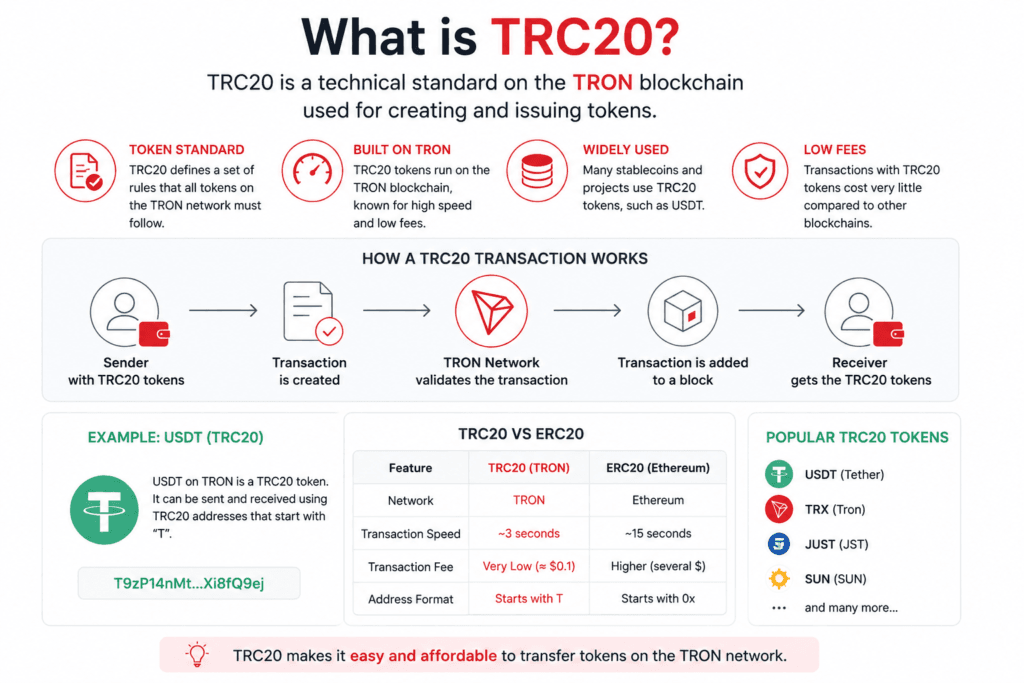
TRC20 is the token standard on the TRON blockchain. It defines the technical rules for creating and transferring tokens — including USDT — on the TRON network. TRC20 is widely used because transfers are fast (under 3 seconds) and fees are under $1, making it one of the cheapest ways to move stablecoins globally.
What Is TRC20?
TRC20 is a technical standard — a set of rules — that governs how tokens are created, transferred and interact with applications on the TRON blockchain. Think of it as a contract template: any token built to the TRC20 specification works automatically with any wallet, exchange or application that supports the standard.
What is trc20?
The most important TRC20 token by far is USDT (Tether). The majority of global USDT transfers — millions of transactions daily — happen over TRC20, specifically because of its low cost and speed. If you’ve ever sent or received USDT, there’s a good chance it moved over TRC20.
TRC20 vs ERC20 in one sentence: Both are token standards — TRC20 lives on TRON, ERC20 lives on Ethereum. TRC20 is faster and cheaper. ERC20 has a larger ecosystem. They are not interchangeable — a TRC20 address is not the same as an ERC20 address.
TRC20 vs Other Token Standards
Token standards exist on every major blockchain. Here’s how TRC20 compares to the most common alternatives.
TRC20 tokens run on smart contracts deployed on the TRON blockchain. The standard defines a set of required functions that every TRC20 token must implement — this is what makes them universally compatible.
Required TRC20 functions (simplified)
transfer(to, amount) // send tokens to an addressbalanceOf(address) // check how many tokens an address holdsapprove(spender, amount) // allow another contract to spend on your behalftransferFrom(from, to, amt) // used by approved contracts to move tokenstotalSupply() // return the total number of tokens in circulation
When you send USDT over TRC20, you’re calling the transfer() function on the USDT smart contract deployed on TRON. The contract updates the balance records and emits a Transfer event — which wallets and explorers use to display your transaction history.
Step 1 — You initiate the transfer
Your wallet calls the TRC20 contract’s transfer() function with the recipient address and amount.
Step 2 — TRON validators process the transaction
TRON uses Delegated Proof of Stake (DPoS) — 27 elected validators process transactions in rotation. Confirmation takes ~3 seconds.
Step 3 — The contract updates balances
The USDT smart contract deducts the amount from your balance and adds it to the recipient’s. This state change is recorded on the TRON blockchain permanently.
Step 4 — TRX is consumed as the fee
The transaction fee is paid in TRX — TRON’s native token. You need a small amount of TRX in your wallet to pay for any TRC20 transfer, even if you’re only moving USDT. This is a common point of confusion for new users.
⚠️ Important: You always need TRX in your wallet to pay TRC20 transaction fees — even when sending USDT. If your wallet has USDT but zero TRX, the transfer will fail. Keep a small TRX balance (a few dollars’ worth) whenever you use TRC20 regularly.
TRC20 and USDT — Why They Became Inseparable
USDT (Tether) is the world’s largest stablecoin — pegged 1:1 to the US dollar. It exists on multiple blockchains simultaneously, but TRC20 has become the dominant network for USDT transfers for one simple reason: cost.
#1
Cost
Under $1 per USDT transfer on TRC20 vs. $2–$20+ on Ethereum ERC20. At scale, this difference is enormous — a company processing 1,000 USDT transfers per day saves thousands of dollars monthly.
#2
Speed
Confirmations in ~3 seconds. Suitable for real-time payments and exchange deposits where speed matters.
#3
Exchange support
Every major exchange — Binance, Abarai, Bybit, Kraken — supports USDT TRC20. It’s become the de facto standard for moving stablecoins between platforms.
Under the Hood: How TRON Processes TRC20 Transactions
TRON’s architecture differs significantly from Ethereum’s, which is part of why TRC20 is cheaper. Understanding the technical differences explains the trade-offs.
DPoS consensus — speed through delegation
TRON uses Delegated Proof of Stake with 27 elected “Super Representatives” who produce blocks in rotation every 3 seconds. This is far more centralised than Ethereum’s ~500,000 validators — which is why TRON is faster and cheaper, but less decentralised. The 27 validators process all transactions, eliminating the bidding war for block space that drives up Ethereum gas fees.
Energy and Bandwidth — TRON’s resource model
TRON doesn’t use a simple gas model like Ethereum. Instead, transactions consume two resources: Bandwidth (for the transaction data size) and Energy (for smart contract execution). Every account gets a free daily Bandwidth allocation — enough for a few simple TRX transfers at zero cost. Staking TRX generates Energy and additional Bandwidth. If you don’t have enough, TRX is burned directly as the fee.
Block structure and Merkle Trees
Like Ethereum and Bitcoin, TRON blocks include a Merkle Tree of all transactions. The Merkle Root in the block header allows lightweight verification — a wallet can confirm a TRC20 transfer was included in a block without downloading the entire blockchain. TRON uses SHA-256 for its block hash (unlike Ethereum which uses Keccak-256).
Which Wallets Support TRC20?
Any wallet that supports the TRON network can hold and transfer TRC20 tokens. The address format for TRON starts with the letter T (e.g. TXyz...) — different from Ethereum’s 0x format.
Ledger — supports TRX and TRC20 tokens including USDT
Trezor — supports TRX (TRC20 via third-party integration)
Critical: Always double-check the network when withdrawing USDT from an exchange. Selecting “TRC20” sends to a TRON address (starts with T). Selecting “ERC20” sends to an Ethereum address (starts with 0x). Sending TRC20 to an ERC20 address — or vice versa — will result in lost funds. Most exchanges display a clear warning, but the responsibility is yours.
Less suitable for complex smart contract applications
Frequently Asked Questions
What is TRC20?
TRC20 is the token standard on the TRON blockchain. It defines how tokens — including USDT — are created, transferred and interact with wallets and applications on TRON. It’s the TRON equivalent of ERC20 on Ethereum.
What is the difference between TRC20 and ERC20?
TRC20 runs on the TRON blockchain. ERC20 runs on Ethereum. They have similar functionality — both are token standards for fungible tokens — but they are completely separate networks. TRC20 is faster and cheaper; ERC20 has a much larger DeFi and application ecosystem. A TRC20 address starts with “T”. An ERC20 address starts with “0x”. They are not interchangeable.
Why do I need TRX to send USDT on TRC20?
Transaction fees on TRON are paid in TRX — TRON’s native token. Even when sending USDT (a TRC20 token), the network charges a small fee in TRX for processing the smart contract call. Without TRX in your wallet, TRC20 transfers will fail. A few dollars’ worth of TRX is typically enough for many transactions.
What happens if I send TRC20 USDT to an ERC20 address?
In most cases, the funds will be lost. TRC20 and ERC20 operate on different blockchains with different address formats. The transaction will broadcast on the TRON network but the ERC20 address may not exist on TRON — or could belong to someone else. Always verify the network before confirming any transfer. Most exchanges display a clear warning about this.
Is TRC20 safe?
TRC20 itself is a well-established standard and USDT transfers over TRC20 are extremely reliable. The main risk is user error — especially sending to the wrong network. TRON’s DPoS consensus mechanism is more centralised than Ethereum’s, which is a consideration for those prioritising decentralisation. For everyday stablecoin transfers, TRC20 is widely considered safe and efficient.
Which exchanges support USDT TRC20?
Virtually all major exchanges support USDT TRC20 — including Binance, Abarai, Bybit, Kraken, Coinbase and Huobi. When withdrawing USDT, select “TRC20” as the network to benefit from lower fees. Always confirm the receiving address starts with “T” before sending.